
What Carp Rig Length Should You Choose?
The length of a carp rig should match the way the setup is presented, the rig construction and the type of lakebed at the fishing spot. In my setups, it is most often 15–18 cm for a casting Combi Rig, around 12–13 cm for a Solid Bag, and 25–40 cm when baiting by boat. I treat these ranges as starting points and adjust them when the rig or hookbait does not settle as intended.
Add Rockworld-carpshop.com to your preferred sources in Google!
Table of contents
- How to correctly measure the length of a carp rig?
- Recommended carp rig lengths
- How to choose a rig length for hard and silty bottoms?
- How to choose the boom length in a Combi Rig?
- How to choose the hair length for the hook and bait?
- When should you shorten or lengthen your rig?
- Questions and answers about rig length
How to correctly measure the length of a carp rig?
Two rigs described as 18 cm may have different dimensions if they were measured between different points. The length of the material itself between the knots and the length of the complete finished rig will be different values.
I measure a finished rig ending in a loop from the end of the loop to the bend of the hook. This measurement therefore also includes the hook. I do not include the hair or the bait mounted on it. This is how the lengths of complete rigs are measured in the examples describing my setups. I discuss the short hook section of the Chod Rig separately.
The measurement is taken on a straightened rig, without excessive tension. Comparing different rigs requires using the same measuring points. When buying a ready-made rig, it is worth checking how the manufacturer defines its length before comparing the stated measurement with your own.
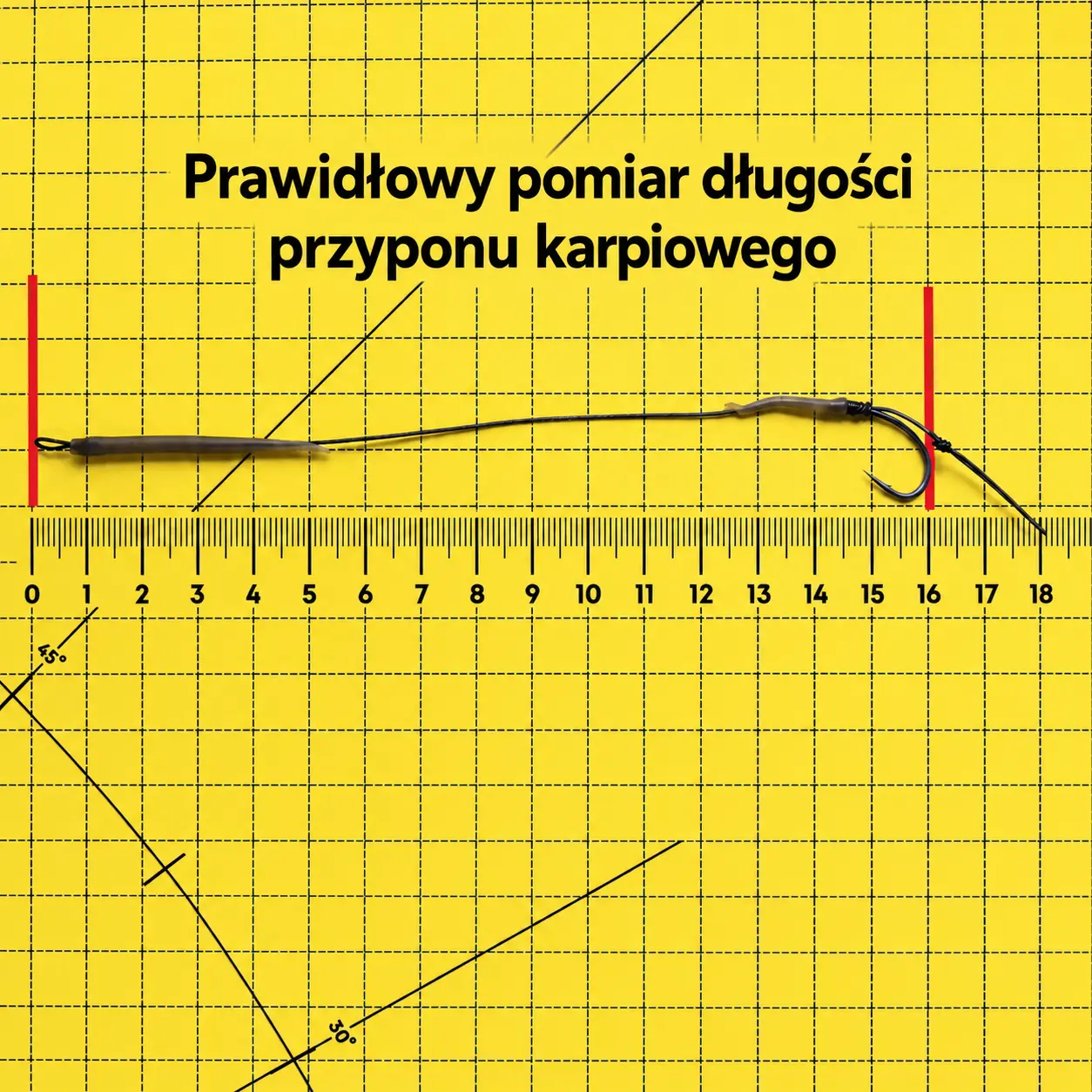
I measure the length of a finished rig from the end of the loop to the bend of the hook. The hair and the bait mounted on it are not included in this measurement.
Rig board for making rigs of the same length
I like to keep rigs of consistent length in my tackle box. When I prepare a batch of 18 cm rigs, I use a simple board with small nails hammered into it. Their spacing allows me to reproduce the same measurement when tying subsequent rigs.
This solution makes it easier to place the rigs in the rig box later on. It also helps maintain order when comparing setups: I know that two rigs prepared as 18 cm really are the same length according to my measuring method.
Recommended carp rig lengths
The ranges below help to initially organise the choice of rig length. They do not set strict limits for every rig used with a given method. I separately indicate the lengths used in my own setups and the short Chod Rig section, which should not be confused with the length of the leader or the distance from the lead.
| Rig type or application | Recommended length | How to understand the stated range |
|---|---|---|
| Chod Rig for a pop-up | Approximately 5–8 cm | Short hook section; leader length and distance from the lead are separate measurements |
| Casting rig | Approximately 10–18 cm | A starting point for selected rigs; my Combi Rig is usually 15–18 cm |
| Solid Bag rig | Around 12–13 cm in my case | The entire rig is placed inside a filled PVA bag |
| Bait boat rig | Approximately 25–50 cm | A range to consider depending on the conditions; I often use 25–40 cm myself |
When choosing a rig, the guide on how to choose a carp rig for the bait and fishing conditions will be helpful. The length should then be selected with a specific rig in mind.
Chod Rig with a short hook section of approximately 5–8 cm
An example of a very short rig is a Chod Rig for floating pop-up baits. Here, approximately 5–8 cm refers to the length of the short hook section, not the entire setup from the lead to the hook. The length of this section and its position on the main line or leader serve different functions.
The short Chod Rig section works in a different setup than a classic bottom rig. For this reason, the 4–8 cm range should not be applied to every pop-up setup. The choice of a floating bait alone does not determine the length of the entire rig.
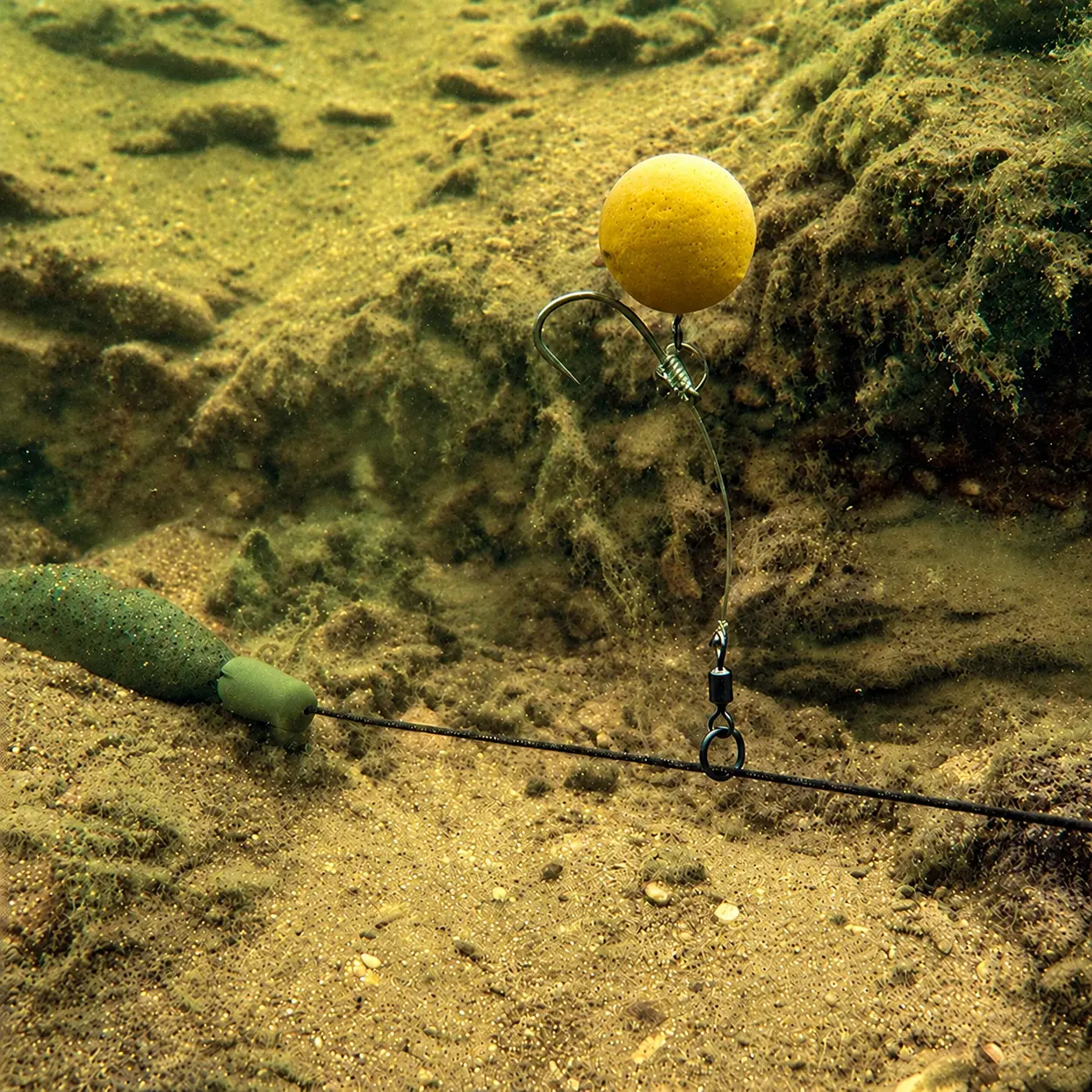
In a Chod Rig, the length of the short hook section and its distance from the lead are two separate measurements.
15–18 cm Combi Rig for casting
Among bottom rigs for casting, lengths of approximately 10–18 cm can be considered. The specific choice depends on the rig design and material; casting alone does not dictate one fixed length.
When casting, I most often use a Combi Rig measuring 15–18 cm. This range suits the way I prepare this rig, combining a stiffer section with a soft section by the hook.
A longer rig may be more prone to tangling during casting and as it falls through the water. Shortening it reduces the amount of loose material, but the effect also depends on its stiffness and the setup design. Soft braid and fluorocarbon of the same length behave differently.
For this reason, when casting further distances, I pay attention to both the length and the material. Simply shortening the rig does not replace proper setup preparation.
Solid Bag rig measuring approximately 12–13 cm
I use rigs shorter than 15 cm, among other applications, in Solid Bags. In my case, they measure approximately 12–13 cm and are placed entirely inside a filled PVA bag together with the remaining elements of the prepared setup and the bait mix.
With this presentation, a short rig fits inside the bag. Soft materials can also be used for this purpose because the rig remains enclosed in the package during the cast. Once the PVA dissolves, its actual presentation on the bottom becomes important.
The length used in a Solid Bag requires reassessment when using a setup cast without a bag. The way the rig is protected and presented changes.
Bait boat rig measuring 25–50 cm
When placing the rig using a boat or bait boat, longer bottom rigs can be considered, approximately 25–50 cm. The upper value is not a goal in itself; the additional length should result from the conditions and presentation requirements.
When using a bait boat, I often use lengths of 25–40 cm. Compared with my casting rigs, this provides more material between the lead and the hook. I take this into account especially when using heavier leads or stone leads on soft bottoms.
When lowering a setup in a controlled manner from a boat, I also use soft braided rigs of approximately 40 cm. I choose them for soft ground when small fish and crayfish are not a major issue and do not constantly move the bait.
However, the long distance of bait boat placement alone does not determine rig length. Above all, I check the conditions where the setup is placed and how its lead behaves.
The stated ranges apply to bottom rigs and the short Chod Rig section. In a classic Zig Rig, the rig length can reach several metres because it is used to set the bait's height above the bottom. When choosing it, the depth of the venue and the bait presentation level are important. Longer rigs are also used in surface fishing, where their length results from the method of presenting the setup rather than the depth of the venue itself; usually, this is a minimum of 50 cm.
How to choose rig length for hard and silty bottoms?
On a clean, hard section of bottom, the lead does not sink in as it does in soft silt. This makes it easier to assess whether a shorter rig suits the selected setup and gives the hook section the necessary freedom of movement.
The situation is different when the lead sinks into sediment. It may pull part of the rig with it, worsen its presentation and draw the bait into the bottom. In such a spot, additional length may be needed so that the section by the hook can remain properly presented.
In my experience, a very soft bottom is one of the reasons for lengthening the rig. When the lead easily sinks into silt, a longer section helps achieve a presentation that was not possible with a shorter version.
However, lengthening the rig does not guarantee correct presentation on every silty or weedy bottom. The setup design and the connection between the rig and the lead also matter. A rig whose hook gets caught in vegetation requires a reassessment of the entire presentation.
Stiffness must also be considered. A long, stiff section may rest on uneven ground, while a more flexible one will adapt to it more easily. The differences between soft braid, coated braid, mono and fluorocarbon are discussed in the guide to choosing rig material.
How to choose boom length in a Combi Rig?
A boom is the section of a rig responsible for a specific action within the setup, most often made from a stiffer material than the section by the hook. The length of the boom itself and the length of the entire rig must be considered separately.
In my casting Combi Rigs, the boom is most often approximately 12–15 cm long. The entire finished rig usually falls within the previously mentioned 15–18 cm range. These are two separate measurements, not values describing the same section.
When using ready-made booms for carp rigs, their stated length refers to the boom itself. The choice of boom also affects the proportions of the Combi Rig. After changing its length, it is necessary to assess the amount of soft material by the hook and check whether the hook section still works as intended. Lengthening the soft section and lengthening the stiff section can result in different rig mechanics, despite a similar overall length.
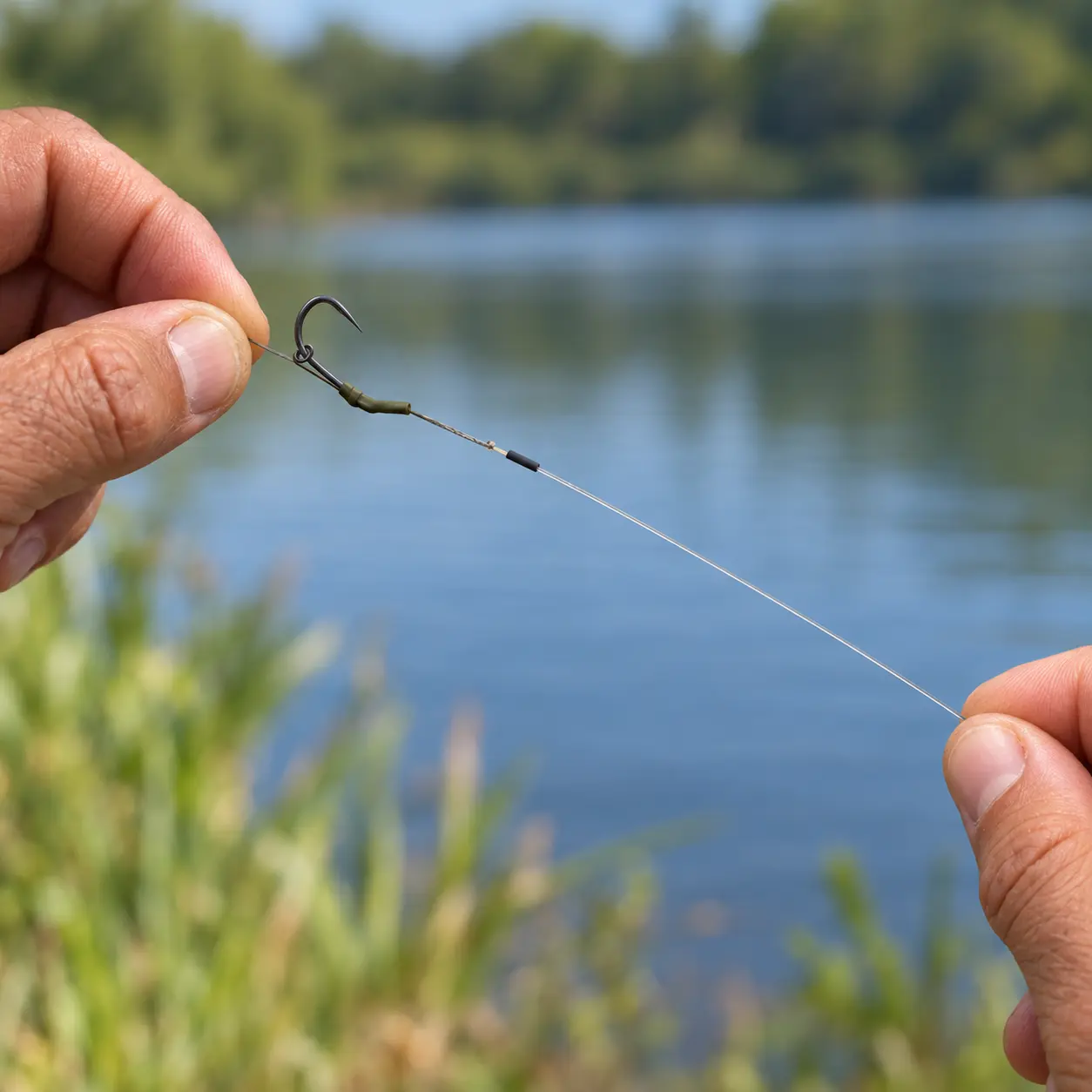
The boom is part of the Combi Rig. Its length must be distinguished from the length of the entire rig including the hook section.
How to choose hair length for the hook and bait?
With a classic hair rig, I distinguish between two measurements. One concerns the length of the hair from where it exits the hook to the loop. The other describes the free space between the surface of the mounted bait and the bend of the hook.
In practice, I find it easier to compare ready-made setups by looking at the latter value. The same hair will leave less free space between the bait and the hook once a larger boilie is mounted. For this reason, I assess the gap with the bait attached to the hair.
Sweetcorn and a 24 mm sinking boilie
With sweetcorn, I leave a small gap: approximately one to one and a half grain widths. This proportion is assessed after mounting the grains, rather than as a fixed measurement in millimetres, because sweetcorn grains can vary in size.
With a large 24 mm sinking boilie in a classic hair rig, I use a much larger gap. In my setups, this is approximately 3–5 cm of free braid between the surface of the boilie and the bend of the hook. This does not refer to the length of the entire hair.
With this arrangement, I want the hook to be able to lie freely and flat on the bottom next to the large bait. This gap is a solution I use for a specific presentation. It is not a recommendation for every 24 mm boilie or every hook pattern.
Wafters and buoyancy control
With wafters, I usually use a smaller gap than with a large sinking boilie. However, I start by checking the bait with the intended hook in water.
A wafter is intended to provide a balanced presentation, but its behaviour depends on the buoyancy of the specific bait as well as the weight of the hook and mounting. The entire setup may slowly settle on the bottom. If the bait itself rises above the hook lying on the bottom, the length of the free hair affects the height to which it can lift.
For this reason, I do not choose hair length solely according to the label on the packet. I check the presentation of the finished combination. After changing the bait or hook, I repeat the test, even if the rig length remains the same. Checking the balance of a wafter with a hook and my method of setting this presentation are described in a separate guide.
The described gaps apply to a classic hair. Rigs with bait mounted on a micro swivel, ring or another component require a separate assessment of the bait's movement in relation to the hook.
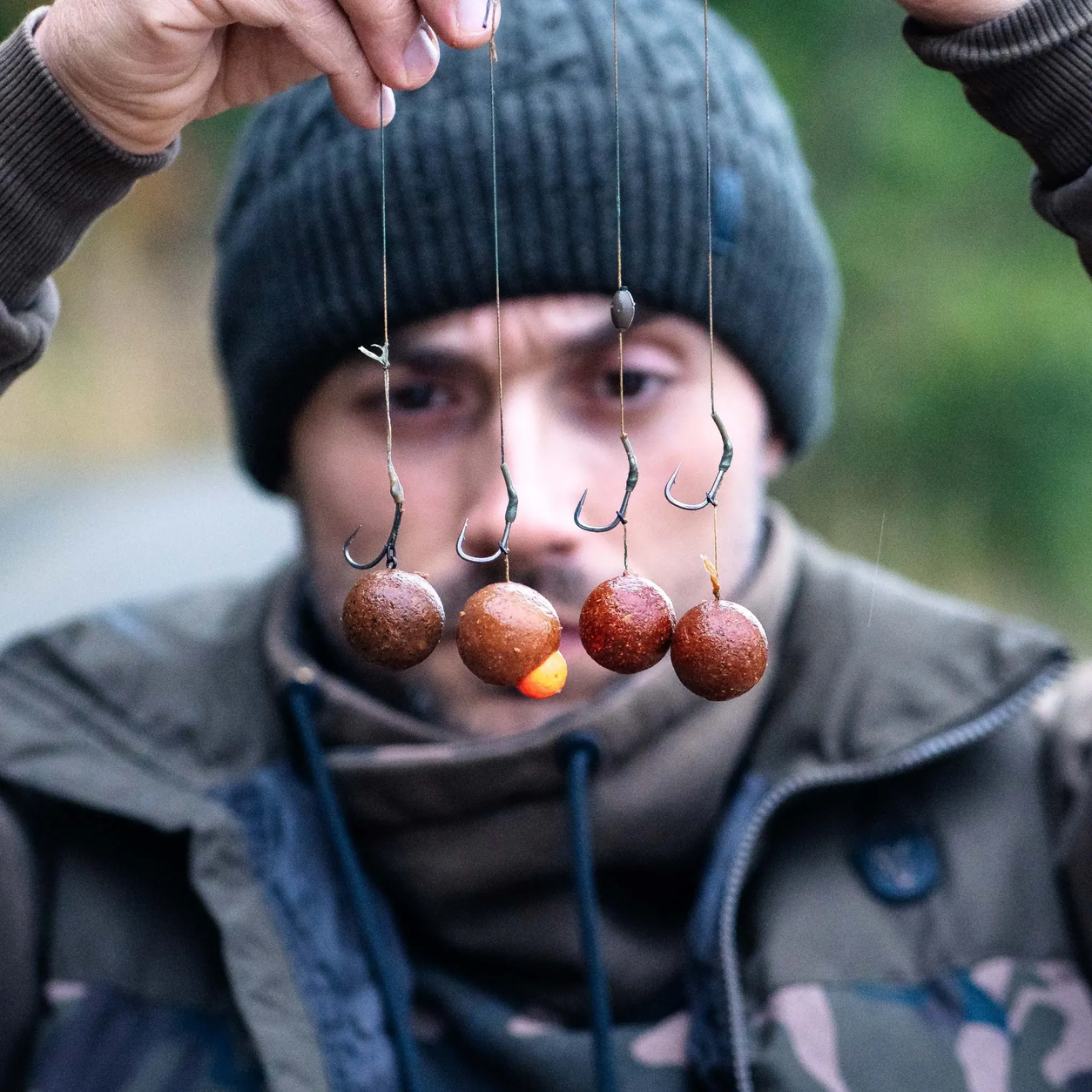
Hair length should be matched to the rig design as well as the size and buoyancy of the bait in order to achieve the correct bait presentation on the bottom.
When should you shorten or lengthen a rig?
Changing the length should result from a specific issue. If the rig comes back tangled after casting, its material, length and preparation for presentation need to be assessed. Shortening may help, but the cause may also be incorrect operation of individual components.
If the lead pulls the rig into sediment on a soft bottom, you can consider lengthening it and checking the connection to the lead. If the issue concerns the bait itself near the hook, its mounting and buoyancy need to be assessed first. Changing the length of the entire rig will not solve every irregularity in this part of the setup.
When comparing rig lengths, it is worth following a simple sequence:
- Determine what needs improving: bottom presentation, reducing tangles or freedom of movement for the hook section.
- Record the length of the finished rig and the method used to measure it.
- Prepare a second version of the same rig, changing the length while keeping the other elements as similar as possible.
- Check the presentation of both rigs with the intended bait and, when casting, also assess the way they are delivered.
- Assess the result based on repeated observations. A single take, or the lack of one, does not determine which length is better.
The most common mistake I see is applying one length to all conditions. A long soft-braid rig that works well for me when lowering from a boat onto silt requires a different approach than a short rig for long-range casting. I also do not treat a short Solid Bag rig as a model for every fishing method.