
Soft braid, coated braid, mono or fluorocarbon – which material for a carp rig?
Choose your carp rig material according to the function required by the selected setup: a soft braid provides freedom of movement, a coated braid allows you to create sections with varying stiffness, while suitably selected mono and fluorocarbon can form stiff sections or complete rigs. The material name alone is not enough — check its actual stiffness, sinking properties and behaviour once combined with the hook and bait.
Add Rockworld-carpshop.com to your preferred sources in Google!
Table of contents
- Hooklink materials — key differences
- Soft braided hooklink: when does its flexibility help?
- Coated braid: how to choose the right coating stiffness?
- Mono or fluorocarbon for a carp hooklink?
- How to check a material’s stiffness, sinking properties and memory?
- When should you replace the material or the entire hooklink?
- The most common mistakes when choosing hooklink material
- Questions and answers about hooklink materials
Rig materials — the key differences
A material can perform several different functions in a rig. Flexibility is often needed near the hook, while a stiffer section helps maintain the intended rig geometry. Both characteristics can be used in a single rig.
If you are just choosing a rig setup, start with the guide on how to choose a carp rig. Choosing the material will be easier once you know how the hook section and the rest of the rig should behave.
| Material | What does it provide in a rig? | Example application | What should you check in particular? |
|---|---|---|---|
| Soft braid | A high degree of movement and the ability to conform to uneven ground | Soft section of a Combi Rig, classic soft rig, Solid Bag rig | Sink rate, fibre condition and the rig's tendency to tangle |
| Coated braid | A stiffer core and the option to strip back a soft section | A rig with a soft section near the hook and a stiffer remaining section | The actual stiffness of the coating, ease of stripping and its tendency to crack |
| Mono | Properties depending on the specific material: from flexibility to retaining a pre-formed shape | Stiff sections, booms and shaped hook sections | Product purpose, memory, stiffness and the method used to create connections |
| Fluorocarbon | A sinking monofilament material available in various stiffnesses | Boom, part of a Combi Rig or a rig made from one material | Suitability for shaping, surface condition and compatibility with the selected joining method |
Stiffness and strength are different properties. The lb rating refers to the declared breaking strain of the material, while its behaviour must be assessed separately. The issue of lb ratings is discussed in the guide hooklink braid strength.
Soft hooklink braid: when does its flexibility help?
The main advantage of soft hooklink braids is freedom of movement. The material bends easily, allowing it to follow the contours of the lakebed and leave a flexible section near the hook.
In my rigs, soft braid most often forms the end section of a Combi Rig. The stiffer section is responsible for positioning the rig, while the soft section allows the hook section to work more freely. One of the materials I like to use is Korda Super Natural.
I choose rigs made entirely from soft braid more deliberately. I particularly like them when carefully lowering a rig from a boat, when I want a flexible setup that conforms to soft or uneven lakebeds. I also take into account the presence of small fish and crayfish, which may move the bait and rig components.
However, flexibility has another side: this type of material can more easily wrap around other parts of the setup. When casting, it requires suitable rig preparation. It is used, among other things, in rigs enclosed in a Solid Bag.
Before purchasing a specific model, you can check our TOP 5 soft hooklink braids list.
Coated braid: how to choose the coating stiffness?
Coated hooklink braid consists of a braided core and an outer coating. The coating gives the material a specific stiffness, while stripping it back exposes the soft braid.
This allows you to achieve sections with different working characteristics without joining two separate materials. This is one of the reasons why coated braids are so versatile.
Soft or stiff coating?
Materials that behave very differently are grouped under the same name. Some coatings are flexible and easily yield under pressure. Others create a distinctly stiff section.
For boat work, I prefer a more flexible coating. It still provides some stiffness, but conforms more easily to the lakebed. For casting rigs, I more often consider a stiffer version, which helps maintain the intended rig arrangement.
Check the material in your hand rather than judging it solely by the label “coated”. Two braids from the same group may require different preparation and work differently once the rig has been tied.
What does partially stripping the coating achieve?
Exposing the core allows you to leave a soft section where freedom of movement is needed. The remaining section retains the properties provided by the coating used.
Where the coating is stripped should result from the rig design. It is worth looking at the effect: whether the hook and its attachment work as intended, and whether the stiffer section still fulfils its function.
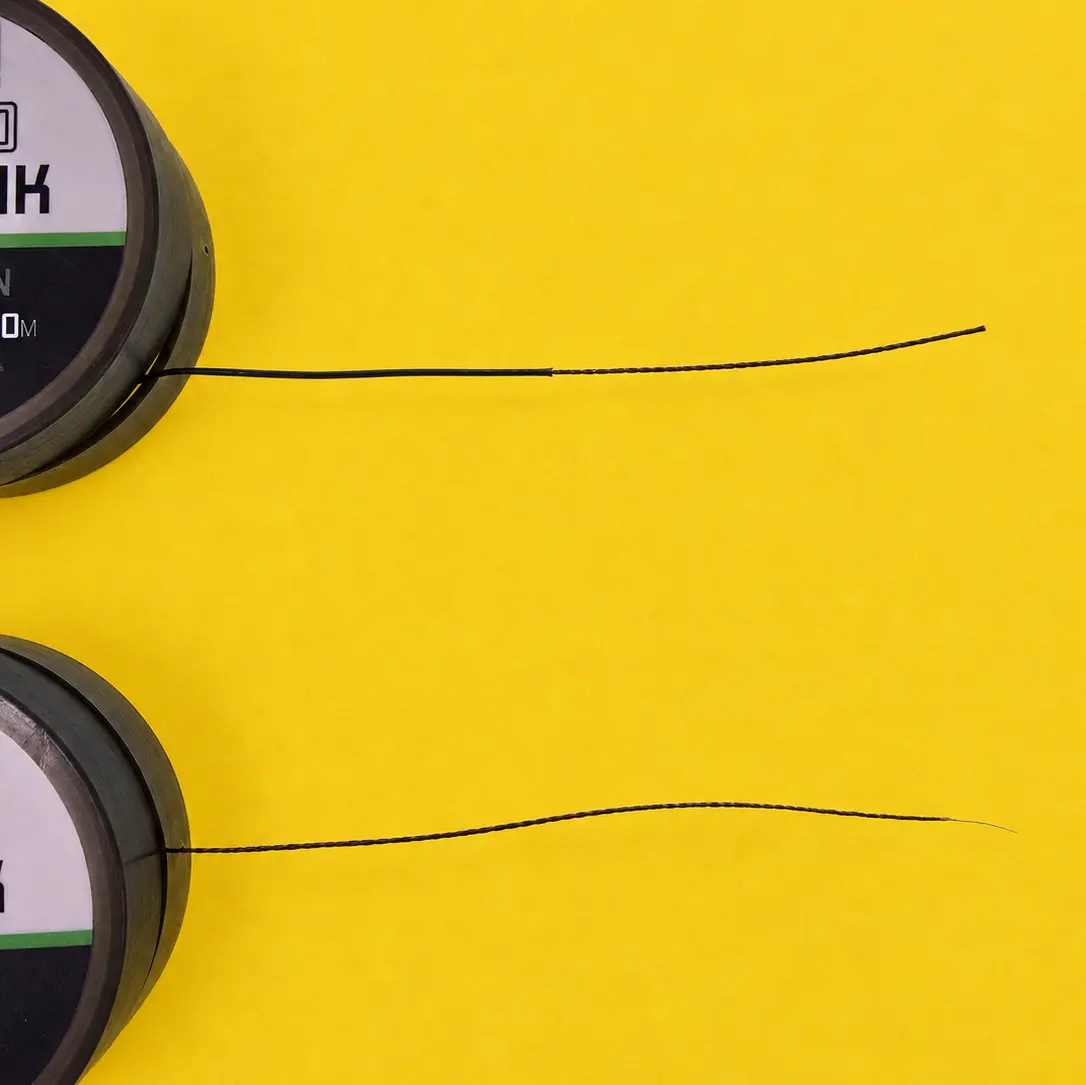
Partially stripping the coating allows you to create a soft section. During this process, the core fibres must remain undamaged.
We compare specific models and their properties in the TOP 5 coated hooklink braids list.
Mono or fluorocarbon for a carp rig?
Mono and fluorocarbon are made from a single strand, which is why they belong to monofilament materials. In this guide, the term “mono” refers to traditional nylon lines and hooklink materials sold under this name.
Mono: check what it was designed for
Among mono materials for carp rigs you will find products with different properties. A soft line and a stiff material that retains a pre-formed curve may look similar on the spool, but they perform different functions.
When choosing, pay attention to the intended use. A material for a shaped hook section should retain its prepared shape. From a straight boom, on the other hand, you expect it to maintain a stiff section and resist unwanted kinks.
The method used to create connections also matters. Tying this type of material, especially in larger diameters, is often difficult; however, loops can be created using crimp sleeves, compressed with a tool specially designed for this purpose.
Fluorocarbon: choosing the stiffness matters greatly
For the stiff section of a rig, I personally most often choose fluorocarbon hooklink material. I trust it because of its sinking properties and its ability to reduce the visibility of the material underwater.
However, I do not choose every fluorocarbon for the same task. I use Korda Boom and IQ2 Soft, among others — both belong to this group, yet differ in stiffness. For casting rigs, I also use Carprus Clearwater.
This is a good example of why the name of the material alone does not determine its application. A distinctly stiff section requires different properties than a rig that needs to yield more easily under pressure.
Practical tip: remove any residue from the surface of fluorocarbon after contact with the lakebed. Material covered in dirt may stand out more from its surroundings. When gently wiping it with a wet, soft cloth, check whether the surface remains smooth. Dirt can be removed; a scratch or nick requires an assessment of the damaged section.
You can find a comparison of specific products in the TOP 5 fluorocarbon hooklink materials list.
How to check the stiffness, sink rate and memory of a material?
It is a good idea to assess the material before tying, and then check the rig once assembled. Only the second stage shows how it works with the hook, bait and other components of the setup.
Stiffness: does the material behave as required?
A stiffer section should maintain the intended arrangement, while a soft one should yield where movement is required. The problem arises when stiffness begins to interfere with presentation.
I pay particular attention to this on lakebeds covered with small twigs or stones. A section that is too stiff may rest on obstacles and stand proud between them. A more flexible material conforms more easily to such a spot.
Also assess the action of the entire setup. If you expect a moving section near the hook, check whether the chosen material actually allows for this movement.
Memory: when is retaining shape an advantage?
Material memory means its tendency to retain a given shape. With a straight section, an unwanted curve after unspooling may need to be removed. With a shaped hook section, retaining the shape can be a desirable characteristic.
This is the case, among others, with a Chod Rig and the hook section of a Hinged Stiff Rig. In these setups, the correctly selected material should retain the prepared geometry.
Match straightening and shaping to the specific product. This also applies to the use of steam or other heating methods — check the manufacturer's recommendations to see whether such treatment is suitable. Often, however, it is enough to prepare such a rig before the session and place it in a rig board, allowing it to achieve a perfectly straight shape.
Sink rate: a simple bucket test
I carry out an initial assessment very simply: I cut off a piece of material and test it in a bucket of water. However, the moment when you begin observing is important.
A section placed on the surface may temporarily remain there due to surface tension. With braid, wetting and air trapped between the fibres also matter. Therefore, I first gently submerge the material itself, and only then observe its behaviour.
You can carry out the test as follows:
- Fill a clean container with water.
- Place a section of material in it.
- Gently submerge it below the surface and allow it to become wet.
- Release the material and observe whether it sinks, remains suspended or returns towards the surface.
- Also check whether it lies freely or retains curves and kinks.
Such a test shows the properties of the material in still water. It does not reproduce the entire lakebed or the way a setup settles after a cast, but it allows for an initial assessment of its behaviour in water.
Second stage: the finished rig with bait
After the initial test, check the assembled rig with the intended bait and connection to the setup. Assess whether the hooklink section sinks and settles as intended, and whether the necessary freedom of movement remains near the hook.
A sinking material alone does not yet determine the behaviour of the entire setup. The hook, bait attachment, its buoyancy and additional components define the final result.
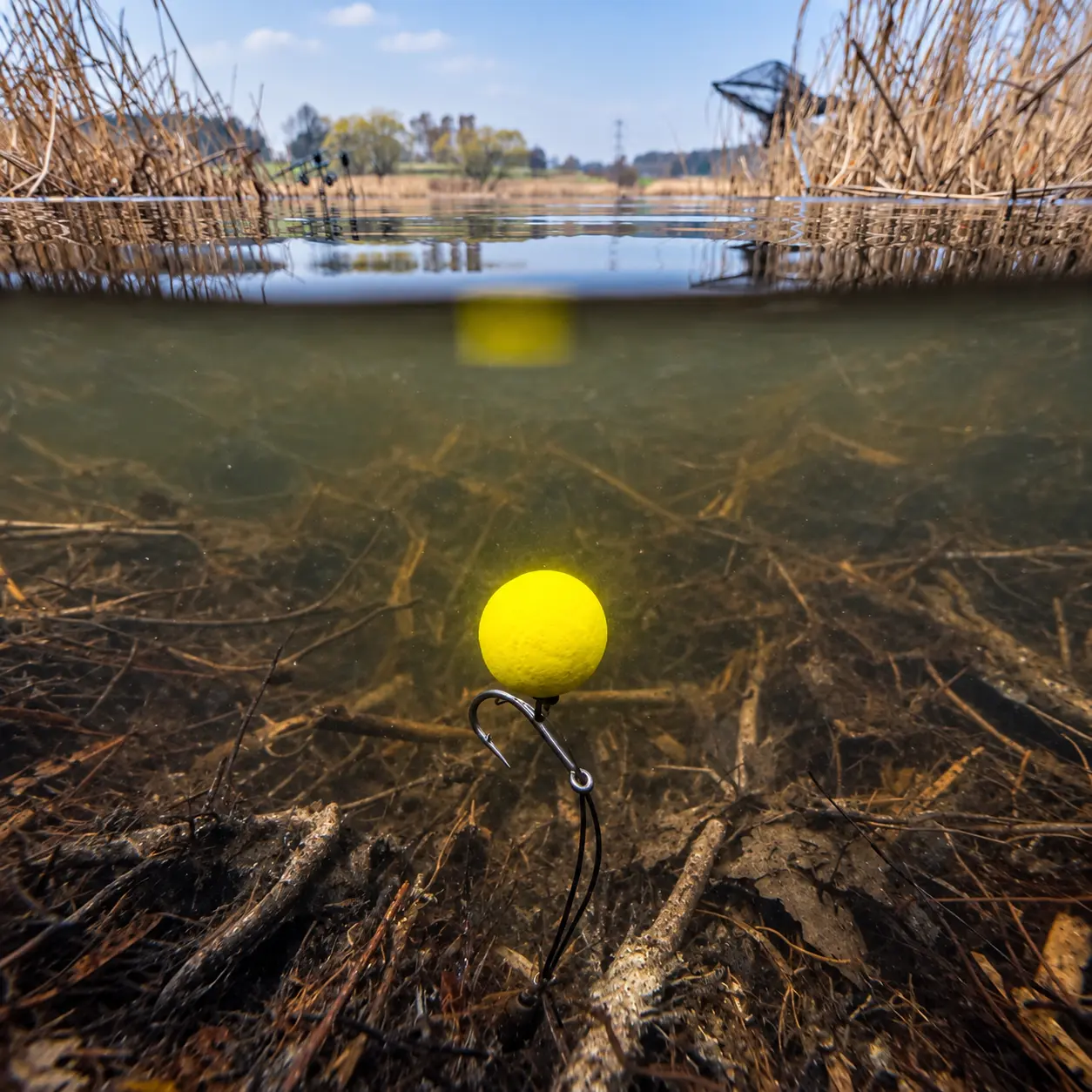
After checking the material itself, test the finished rig with bait. This will show how the entire setup behaves.
When should you replace the material or the entire rig?
After playing a fish or making contact with an obstacle, check the hooklink section and the areas around the connections. Look for changes to the surface and places where the material begins to behave differently. Carp fishing often involves waiting several or even dozens of hours for one take, so it is important that every part of the carp setup is properly selected and undamaged.
Mono and fluorocarbon
With monofilament materials, look for nicks, noticeable abrasions, flattening and sharp kinks. Check them visually and gently between your fingers.
The high abrasion resistance of fluorocarbon does not allow you to determine how much strength remains after damage. If you find a damaged section, replace it or tie the rig again using undamaged material.
Pay particular attention to areas near knots and crimps. The fact that the connection is still holding is not sufficient to assess its condition.
Braid and its coating
With braid, look for frayed, broken or clearly worn fibres. In coated material, assess the core and coating separately.
Cracking of the coating itself can create a soft point in a place that was intended to remain stiff. The rig may then tangle more easily or settle differently. Even if there is no visible damage to the fibres, check whether the setup has retained its required properties.
I use a suitable stripper to remove the coating. I have never personally damaged the core during this process, but after exposing the braid, it is always worth inspecting its fibres. Visible, heavy fraying is a sign that the section should be replaced.
The most common mistakes when choosing hooklink material
- Buying solely based on the group name. Two fluorocarbons or two coated braids may have clearly different stiffnesses.
- Treating greater stiffness as an advantage in every setup. The material should maintain the required geometry while allowing movement where the rig requires it.
- Assessing sink rate only on the water surface. First submerge and wet the section of material.
- Ending the test with the material alone. Repeat the test after assembling the rig and attaching the bait.
- Ignoring cracks in the coating. The coating affects how the setup works, even if the core appears undamaged.
- Using one connection method for all materials. Choose the knot, crimp and processing method according to the properties of the product.
The most useful habit is simple: first determine the required action of the material, then check it on the finished rig.