
Carp Rigs — How to Match a Rig to the Bait and Fishing Conditions?
Choose your carp rig to suit the bait type, rig presentation method and conditions at the venue. It should allow for proper bait presentation, free hook movement and reduce the risk of tangles during casting and the drop. Below, we explain how to combine these requirements and when to choose a complete ready-made rig, ready-made sections or tie your own.
Add Rockworld-carpshop.com to your preferred sources in Google!
Table of contents
- What is a carp rig?
- How to match a rig to the bait, fishing method and lakebed?
- Types of carp rigs — what are the differences?
- Which carp rig should you choose to get started?
- Ready-made rig, ready-made sections or tying your own?
- The most common mistakes when choosing a rig
- Carp rig questions and answers
What is a carp rig?
A carp rig is the final section of the setup, consisting of a hook and bait attachment. Its construction affects how the bait is presented and how the hook behaves when taken by the fish. The rig material and length, hook section design, bait position and compatibility of the individual components all matter.
It is worth distinguishing between several terms that often appear when shopping:
- Complete rig — a ready-made construction including the hook section and the remaining part of the rig. It still needs to be connected to a suitable carp setup and baited.
- Hook section — the part of the rig with the hook and components specific to a given construction. It needs to be connected to a separate boom.
- Boom — a section of rig material with ready-made loops, connecting the hook section to the rest of the setup. It is usually stiffer, made from mono, fluorocarbon or coated braid, and helps keep the hook section away from the lead.
- Leader — a section placed before the rig, serving a function that depends on the setup design. It is not a replacement for a hook rig.
- Terminal tackle — the entire section starting from the point where it connects to the main line.
A ready-made hook section and a complete ready-made rig are different products. The name „Ronnie Rig” or „Combi Rig” on the packaging alone does not yet explain which components are included.
How to match a rig to the bait, fishing method and lakebed?
It is worth starting your rig selection with three questions: what bait will you be using, how will you present the setup (casting or bait boat), and what type of bottom will it be fishing over? Each answer may affect your choice of rig construction.
Bait type and intended presentation
Sinking baits, wafters and pop-ups behave differently once attached to the hook. The rig should match the presentation you want to achieve.
- Sinking bait — a classic hair rig, Blow Back Rig or Combi Rig with a suitable hook section can be a starting point.
- Wafters — it is worth considering, among others, a Blow Back Rig, KD Rig or a suitable D-Rig variant. Matched Ronnie/Spinner constructions can also be used.
- Pop-ups — common choices include the Ronnie Rig, Hinged Stiff Rig or Chod Rig, depending on the fishing spot and the design of the entire setup.
These are examples you can use as a starting point. Ultimately, test the specific bait combined with the specific rig in water. Its buoyancy must work together with the weight of the hook, bait attachment and any additional weighting. The word „wafters” or „pop-up” alone is not enough to assess the final presentation.
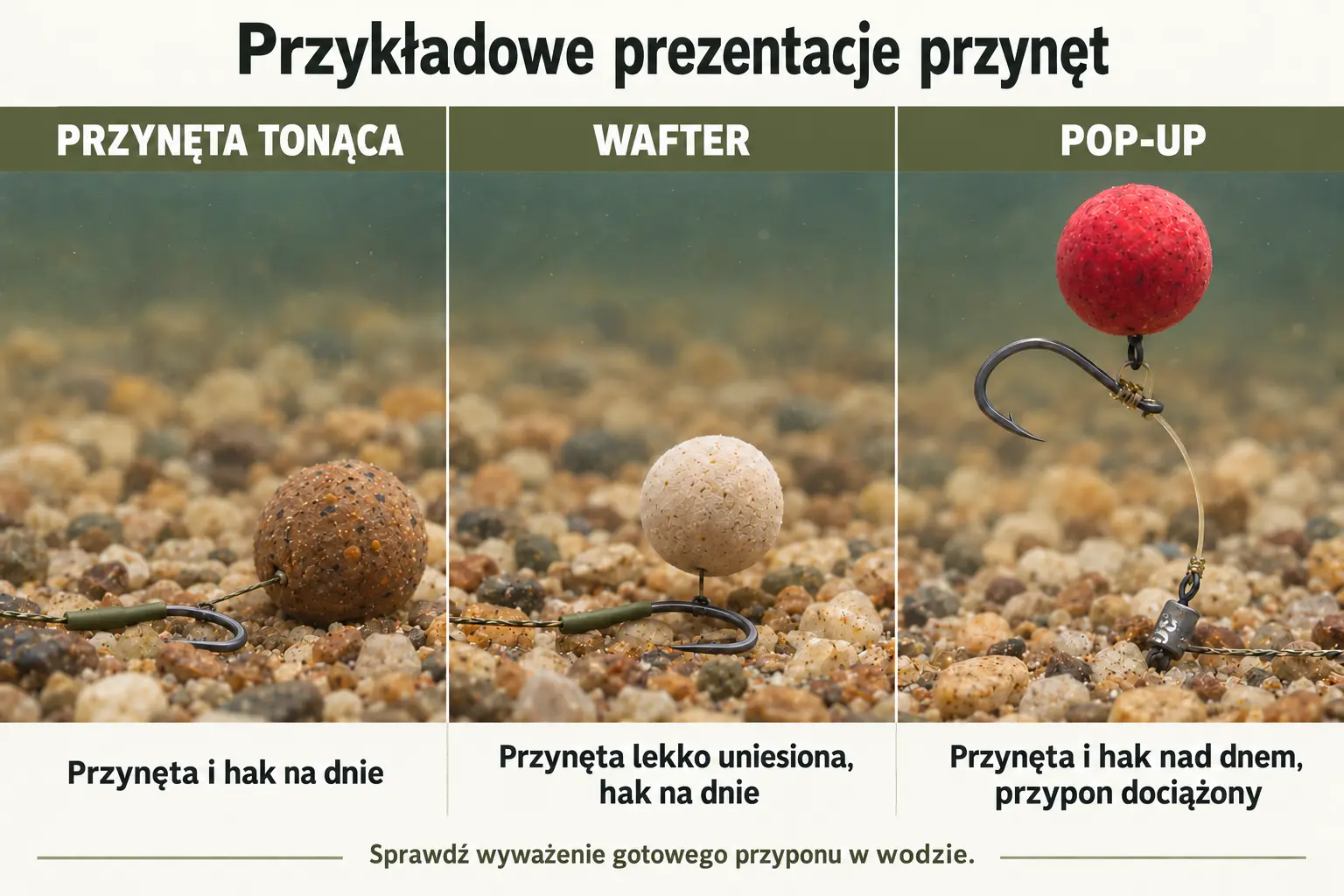
Example rig presentations with sinking bait, a wafter and a pop-up. Before casting, check the position of the bait and hook in water, as well as the balance of the entire rig.
For wafters, I often choose Blow Back and KD Rig constructions. When using a pop-up, Ronnie Rig is often my choice, while over low weed I also consider a Hinged Stiff Rig. These are starting points that I always relate to the conditions at a specific spot.
I discuss bait balancing and hook positioning in more detail in the guide how to match the presentation to the bait type.
Casting, bait boat and dinghy
The method of presenting the setup affects what happens to the rig before it reaches the bottom.
When casting, the rig must cope with the flight of the setup, contact with the water and sinking. A stiffer section, suitable length or proper rig protection helps limit tangles. Soft braid can also be used for casting, for example in a properly prepared Solid Bag setup that uses dissolvable PVA bags.
When using a bait boat, the setup is usually released from the hopper and falls without the angler having direct control over the rig. For this reason, I often choose constructions with a stiffer section that helps keep the hook section away from the lead – a model almost identical to one used for casting, but usually slightly longer.
When placing the setup from a dinghy, you can lower it more calmly and control this stage of presentation better. This gives you greater freedom to use soft materials. You still need to consider water movement, weed and the contours of the bottom.
Using a bait boat and placing the setup from a dinghy therefore place partly different demands on the rig. In both cases, it is worth assessing how it falls through the water, rather than only the fact that the setup is not cast with a rod.
Example lengths and the method of measuring a ready-made rig are discussed in the guide how to choose rig length for casting and bait boat fishing.
The bottom at the location where the setup is placed
On a clean, even bottom, it is easier to predict how the rig will lie. You can then use a construction with a stiffer section, while allowing suitable freedom of movement around the hook. A stiff construction has the advantage of being less prone to tangles while resting on the bottom as well; water movement caused by feeding fish and small fish feeding in the area can tangle the setup.
On an uneven bottom, a soft material may adapt better to the contours of the lakebed. However, the flexibility of the rig alone does not solve the problem of deep silt or dense weed. You need to check whether the bait and hook remain accessible to the fish.
In such conditions, consider changing the presentation, method of delivery or the fishing spot itself. Chod Rig and Hinged Stiff Rig can be useful here, but they also require matching to the actual bottom conditions and proper setup.
Above all, assess the exact spot where the bait is to be placed. General information that a lake has a hard or silty bottom may not be enough; it is better to verify this using a fish finder or a lead attached to a rod for feature finding.
Types of carp rigs — what is the difference?
Rig names describe different features of their construction. Some refer to the combination of materials, while others refer to bait attachment or the action of the hook section.
Combi Rig and Blow Back Rig can both be present in one rig. The first name describes the combination of a stiff and soft section, while the second describes the way the hair is guided around the hook.
| Construction | What distinguishes its design? | When should you consider it? |
|---|---|---|
| classic knotless knot rig |
A simple hook section with bait mounted on a hair. | As a starting point for sinking bait or a wafter on a known, clean bottom. |
| Combi Rig | A stiffer section combined with a soft section near the hook. | When you want to combine anti-tangle properties with free movement of the hook section; a good choice for casting. |
| Blow Back Rig |
A rig ring on the hook shank guides the hair and allows it to move. | For properly matched sinking baits and wafters; it is also often used as a Combi Rig hook section. |
| KD Rig |
The distinctive way the hair exits affects the position of the hook in relation to the bait. | For a properly matched, balanced presentation, including with wafters. |
| D-Rig and Slip D-Rig |
The bait attachment uses a D-loop; the material and movement of the loop depend on the variant. | When you need a specific amount of bait movement at the hook. Suitable for pop-ups or wafters. |
| Ronnie Rig / Spinner Rig | A rotating connection between the hook and the remaining part of the rig. | Most often for pop-ups, and in suitable variants also for wafters and sinking baits. |
| Chod Rig | A short, stiff pop-up section working in a properly prepared helicopter setup. | For specific conditions involving soft or debris-covered bottoms. Designed for fishing with buoyant baits. |
| Hinged Stiff Rig | A stiff hook section connected to a boom with a hinge. | For pop-ups, including over low weed and small amounts of debris on the bottom. |
| Zig Rig | The rig keeps a buoyant bait at a selected depth in mid-water. | When you want to fish off the bottom, at the depth where fish are holding, or almost on the water surface. |
You do not need to learn every construction straight away. At the start, it is more useful to understand a few rigs and their limitations than to collect many variants whose behaviour you cannot assess.
Which carp rig should you choose to start with?
For a beginner carp angler, I match the rig to the fishing method they actually intend to use.
For sinking bait or a wafter, clean bottom and casting, a Combi Rig with a Blow Back hook section can be a good starting point. The stiffer section helps limit tangles, while the soft section allows freedom of movement around the hook.
This is also the construction I use most often when casting. I use a stiff fluorocarbon or suitable mono section combined with soft braid and a Blow Back section with a ring guiding the hair. It is a solution I know well and can consciously adapt to my bait and fishing spot.
When lowering the setup in a controlled manner from a dinghy, you can also start with a classic soft braid rig tied with a knotless knot. The condition is that it lies properly on the bottom and is matched to the bait – when using a buoyant bait, you should additionally place a small weight on the braid in the form of a lead shot or tungsten putty, usually around 2–3 cm from the hook eye.
When using a bait boat, it is still worth considering a construction with a stiffer section. Taking the setup out by boat does not eliminate the risk of tangles during release and descent.
If you are not yet confident in tying your chosen construction, you can start with a well-matched ready-made rig. This will allow you to learn its design and behaviour before you start changing individual components yourself.
Ready-made rig, ready-made sections or tying your own?
The choice depends on how much flexibility you need and how you want to prepare your tackle. Each of these options can be useful for both beginner and experienced carp anglers.
Complete ready-made rig
Ready-made carp rigs work well for anglers who want to shorten preparation time, are not confident tying rigs, or experience difficulties related to eyesight and hand dexterity. They are also used by experienced anglers who need a particular construction without making it from scratch.
Before buying, check:
- whether the product is a complete rig or only part of one;
- which bait and presentation it is intended for;
- which hook, bait attachment and rig end it has;
- its length, material and stated breaking strain;
- whether the hook used complies with the fishery rules.
We discuss hook selection in the guide which hook size to choose for carp, while markings and material applications are covered in the article about hooklink braid strength.
A ready-made rig also needs to be tested with your chosen bait. The range of available adjustments depends on its design — some components can be changed or adjusted, while others have fixed parameters.
Ready-made hook section and boom
Combining ready-made hook sections with ready-made booms for carp rigs gives you greater influence over the rig construction without having to tie every part from the beginning.
You can choose the boom length and suitable hook section variant, provided that their ends and connection methods are compatible. Such solutions are found, among others, in Ronnie/Spinner and Combi Rig constructions.
A practical advantage can be the ability to replace only the worn component. If the hook becomes blunt but the boom remains serviceable, the hook section can be replaced in the appropriate construction. If the boom is damaged, a serviceable hook section can be used with a new section.
Check component compatibility for the specific product. A shared rig family name does not mean that any section will fit every boom.
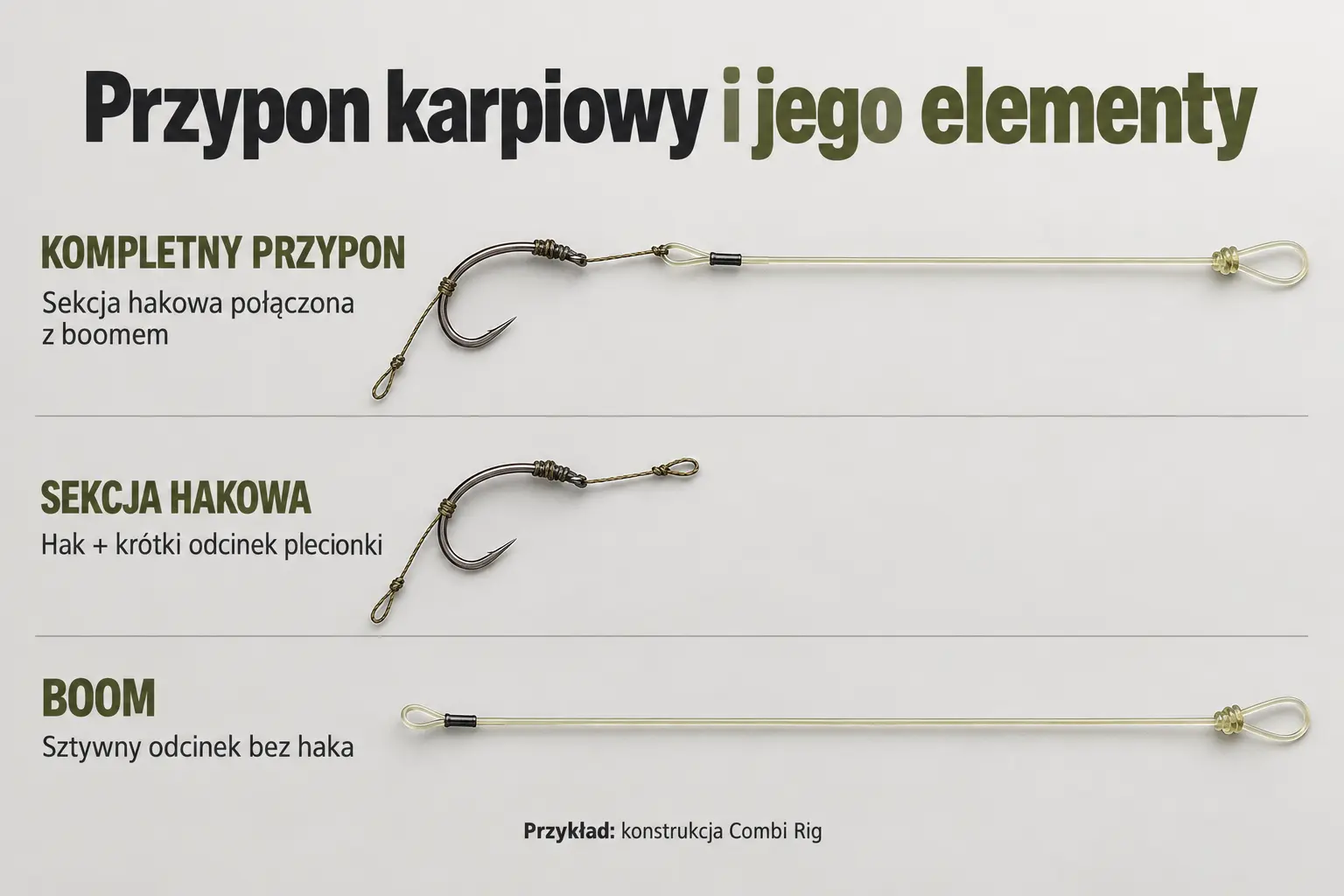
A complete rig, hook section and boom contain different components. Before buying, check which parts still need to be connected.
Tying your own rigs
Making your own rig gives you the greatest freedom in selecting the material, hook, length and bait attachment. Personally, this is the option I use most often because it allows me to match the construction to a specific situation.
However, it requires knowledge of how the rig works and how to make connections correctly. The ability to change every component only has value when you know what effect you want to achieve.
When choosing hooklink materials, consider their properties and compatibility with the chosen construction. Soft braid, coated braid, mono and fluorocarbon offer different possibilities, but only perform specific functions as part of a correctly made rig.
Most common mistakes when choosing a rig
Ignoring the risk of tangles
One of my customers was casting with a classic rig made entirely from soft braid. At first, he was able to present the setup without tangles and catch fish. After one evening cast, he did not get a take all night, and later found that the rig had tangled.
I suggested keeping the hook section design he knew and using coated braid, with a soft section left near the hook. According to his account, the tangling problem stopped occurring during his following trips.
This example shows the importance of matching the material to the method of presenting the setup. Soft braid may require different protection than a construction with a stiffer section.
Copying a rig without considering the conditions
A rig that is effective for another angler can be a good reference point. Before copying it, however, check what bait it is used with, how it is presented and what bottom it works over.
It is particularly important to distinguish between using a bait boat and lowering the setup in a controlled manner from a dinghy. Both methods are referred to as bait boating, but the way the rig is delivered can be different.
Judging quality solely by price
Assess rig quality based on the components used, the workmanship of the connections and the compatibility of its elements. Important factors include hook sharpness, the quality of the hooklink material and the freedom of movement of parts that should work properly in a given model.
A high price does not replace matching the rig to the conditions. The usefulness of a particular product is determined by its design, workmanship and correct application.
Attributing every lack of takes to the rig
A lack of takes does not in itself indicate the cause. The fish may not have been present in the spot you were fishing, or they may not have been feeding at the chosen depth.
A tangled rig, masked hook or incorrect presentation are specific reasons to improve the setup. It is worth checking them, but changing the rig alone will not solve every problem during a session.
Start with the bait, consider the delivery method and confirm the bottom conditions. Only then choose the construction.