
What distinguishes a carp rod from a feeder rod and other rods?
The carp rod is designed specifically for carp fishing, focusing on presenting rigs and controlling large fish during the fight. It differs from a feeder rod primarily in the way bites are signaled and its usage style, and from float or spinning rods by the tasks it is intended for. Understanding these differences helps you determine when a carp rod will truly be useful on your fishing sessions.
Add Rockworld-carpshop.com to your preferred sources in Google!
What distinguishes a carp rod?
The carp rod, commonly called a carp rod, is designed to enable effective presentation of the rig and efficient landing of carp, even larger specimens. Its construction is tailored to specific tasks: casting carp rigs from the shore, boat delivery of rigs with bait boats, landing fish from the bank, or operating gear from a pontoon.
Carp rods do not form a single, uniform group in terms of power and bending action. Among them are models that work deeply under load, versatile constructions, and rods primarily designed for long-distance casting. This allows you to always select gear suited to the conditions in which it will actually be used.
During a typical carp session, the carp rod rests on rod rests or rod pods. Bites are usually indicated by an electronic bite alarm cooperating with a mechanical indicator (hanger or swinger) attached to the line. The angler picks up the rod to respond to the bite and start the fight.
The biggest advantage of specialization is the ability to match the gear to the planned fishing method. Different carp rods meet different needs — from comfortable maneuvering in tight spaces while actively searching for fish in hard-to-reach spots, to casting rigs at longer distances or delivering rigs by boat.
Carp rod vs feeder rod — key differences
Feeder and carp rods can be used to catch almost the same fish, but the way you organize your fishing differs. You will notice the difference already when setting up your fishing spot, then while watching for bites, and later during the fight.
| What do we compare? | Typical carp rod during a session | Feeder rod |
|---|---|---|
| Bite indication | Usually an electronic bite alarm plus a hanger or swinger | Watching the movements of a sensitive tip |
| Tip section | Strong blank section working during casting and fighting | Sensitive, usually interchangeable tip indicating bites |
| Most commonly used rigs | Carp rigs with lead weight, with lead and soluble PVA material | Rigs with classic feeder cage or method feeder |
| Fishing spot setup | Rod placed on rests to work with bite alarms, does not require constant angler presence right next to the rod | Rod positioned for good visibility of the tip and quick reaction to bites, requires constant angler presence right next to the rod |
How do you detect a bite?
In feeder fishing, you watch the tip. Its bending, vibrations, or straightening can signal bait uptake and fish movement. Therefore, the rod’s position and visibility of its tip are very important.
The delicate feeder tip is primarily for reading bites. You should not judge the rod’s overall fighting ability based solely on the tip’s thickness, although it must be properly matched to the casting distance or fishing conditions.
With a carp rod, it’s different. On my carp sessions, I use an electronic bite alarm and a hanger or swinger. The latter is a mechanical indicator attached to the main line. In this setup, I get bite information from the line movement and the alarm’s signals.
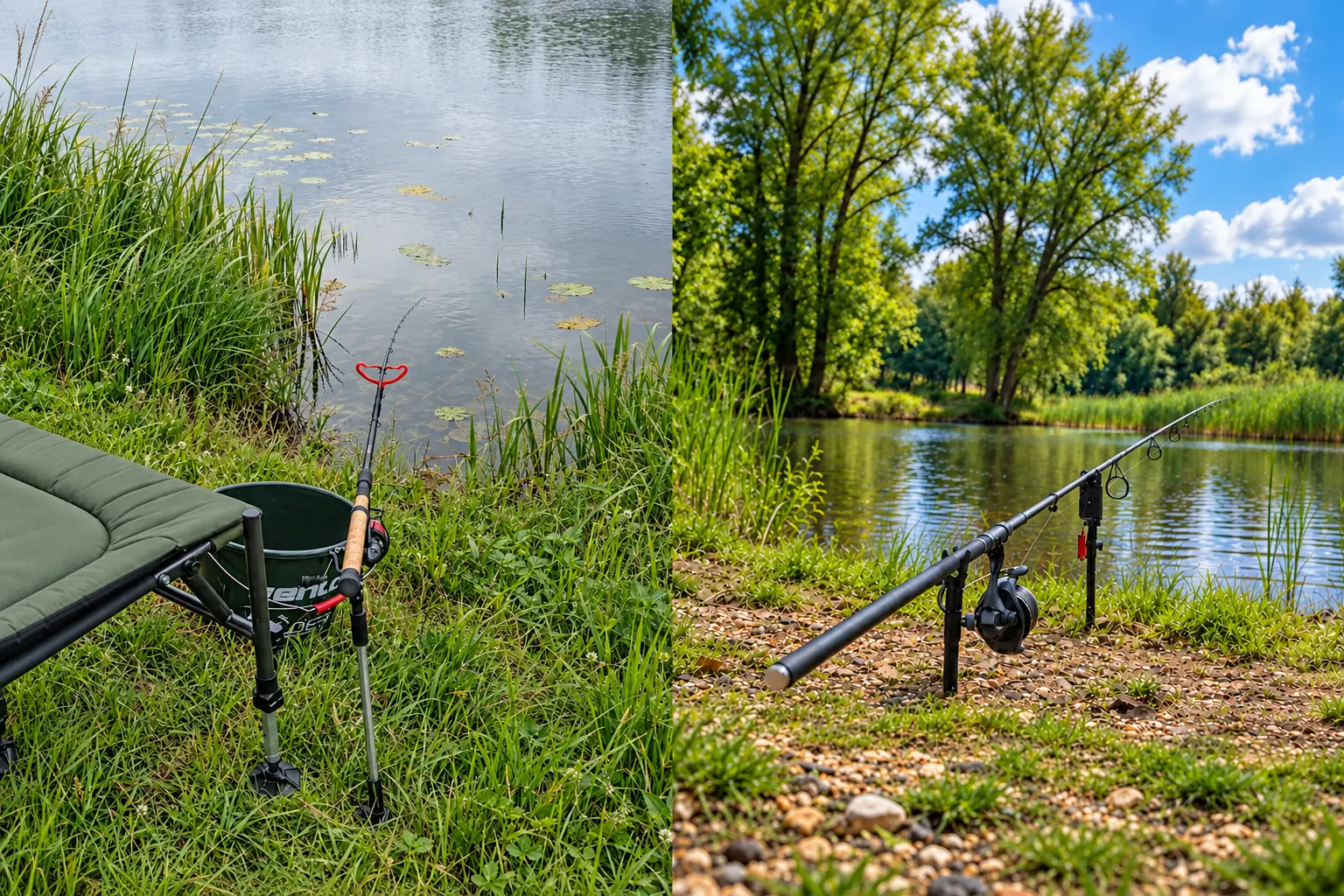
Caption: In feeder fishing, the tip indicates the bite. During a typical carp session, you use an electronic bite alarm and a mechanical indicator on the line.
What changes during the fight?
I personally fish with both typical carp rods and feeders. Comparing the gear I use, I clearly feel the difference already with carp weighing about 5 kg. Fighting such a fish on a feeder is more demanding, while a typical carp rig gives me more power reserve, making it generally easier to land the fish.
When regularly targeting bigger fish, this power reserve can be significant. A properly chosen carp rod allows effective fighting of large, often double-digit kilogram carp with much greater success, especially when the fishing conditions are challenging (possible underwater obstacles where the fish can swim, dense vegetation).
However, this does not mean that feeders are only for small carp. There are commercial models suitable for catching large fish as well, but compared to carp rods, they are much more delicate constructions.
Do you fish at a similar pace with both rods?
In feeder fishing, regular feeding with the feeder cage is often part of baiting. You observe fish reactions, change bait, and adjust casting frequency. The ease of repeating these actions matters throughout the session. This type of fishing is therefore quite fast-paced and more engaging.
During a carp session, the rig can stay longer in a chosen spot, often several or even dozens of hours. Then, preparing the spot for waiting for bites and later handling the fish plays a bigger role. The angler has more freedom and does not need to constantly watch the rod because the bite alarm does it for them.
These are typical differences, not rigid rules. You can also wait longer for bites with a feeder, and carp fishing may require frequent recasting of rigs. The fishing pace should depend on the situation at the water.
How does a carp rod differ from a float and spinning rod?
Carp rod vs float rod
In float fishing, the float signals the bite. The rod allows rig presentation, line control, hooking, and fighting. Its construction depends on the technique — distance rods, light rods, and pole rods meet different needs.
You can deliberately catch carp with a float rod. There are also models designed for this purpose, including pellet waggler rods. If you plan to fish this way, a suitable float rod remains the right tool.
A carp rod, even with the lowest bending curve, remains a rather "sturdy" rod. There are specialized carp rod models used for surface fishing methods, but it will still be a rod that is not suitable for classic float rigs where the float has only a few grams of buoyancy.
Carp rod vs spinning rod
In spinning, you regularly cast and retrieve the lure, working the rod and reel. The gear stays in your hand for much of the fishing. Its balance, grip comfort, and ability to transmit information about lure action and fish contact are important.
A typical carp rod works in a different rhythm. While waiting for a bite, it rests on rod rests, and you mainly use its capabilities when casting the rig and fighting the fish.
The ability to cast a lure with a given rod does not mean it will be comfortable for hours of retrieving. That’s why a carp rod certainly won’t replace a well-chosen spinning rod, just as a spinning rod won’t meet the typical demands of carp sessions.
When is it worth switching to a carp rod?
The moment to buy a carp rod comes when your plans become more specific. You increasingly choose waters targeting bigger carp or prepare for longer sessions. Then it’s worth checking if your current rod suits these tasks.
I started with a telescopic rod I received, not yet familiar with parameter selection. Over time, I noticed situations where it stopped meeting my needs. I chose the next gear with greater awareness of what I need at the water.
Three situations especially support choosing a carp rod:
- You regularly target bigger carp. You want to prepare gear for fighting them in the conditions where you plan to fish.
- You are developing your fishing method. You plan to fish heavy rigs, deliver rigs by pontoon, or use rigs that your current rod does not comfortably handle.
- You notice specific limitations of your current gear. You lack the ability to cast heavy rigs at longer distances or enough power reserve when fighting big fish.
A carp rod lets you tailor these features to your needs. You can look for a model focused on casting, a construction comfortable for boat delivery and fighting from a pontoon, or a rod combining several uses. However, a carp rod with universal parameters often suffices at the start.
Changing gear does not have to be triggered by exceeding a certain fish weight. A feeder may still suit your fishing style with a sensitive tip. But if you increasingly plan typical carp sessions, a specialized rod becomes a justified direction for gear development.
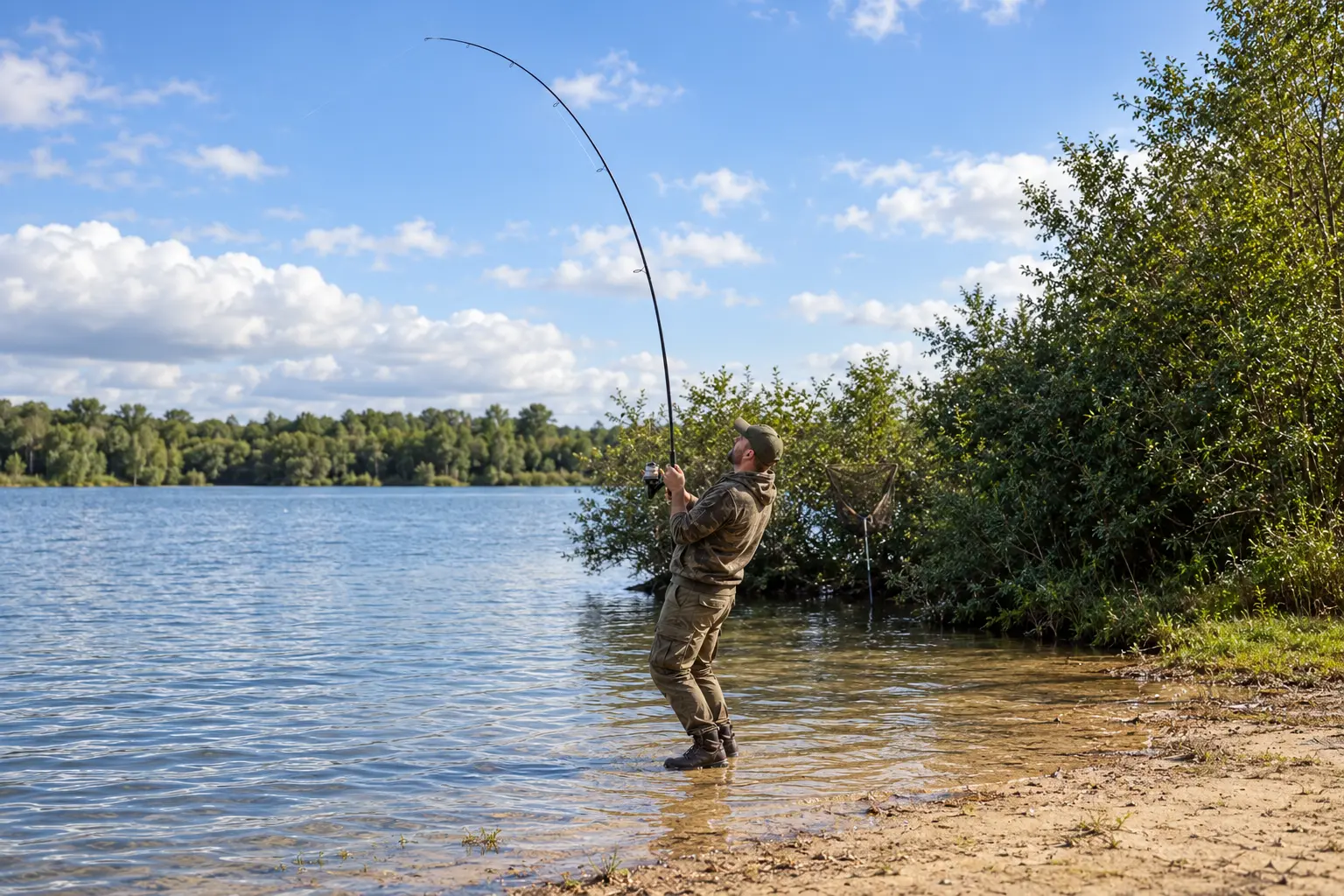
Caption: A properly chosen carp rod combines the power reserve needed during the fight with blank action matched to the fishing style.
How to choose a carp rod for your fishing style?
If you want to focus on specialized carp fishing, the next step is to match the rod to your sessions. This way, you will use its capabilities both when presenting the rig and during the fight.
In the guide how to choose a carp rod, we show how to combine fishing style with the right length, bending curve, blank action, and construction. This will help you narrow down your choice to rods that meet your needs at the water.