
Bend Curve and Action of a Carp Rod — What Do lb Mean and How to Choose the Parameters?
The bend curve given in lbs describes the load required for a specific rod bend, while the action refers to how the blank performs. Therefore, two carp rods marked as 3.50 lb can differ significantly during casting and fighting. To properly select your gear, it’s also important to understand its dynamics — the speed of recovery and damping of vibrations after bending.
Add Rockworld-carpshop.com to your preferred sources in Google!
Table of contents
- What do lb mean and how is the rod bend curve measured?
- How to understand parabolic, progressive, and tip action?
- Action vs. blank dynamics — what does a "fast rod" mean?
- Why can two 3.50 lb rods perform differently?
- Carp rod 3.00, 3.25 or 3.50 lb — how to choose?
- Rod bend curve vs. casting weight — how to consider your rig and PVA?
- How to assess rod performance before purchase?
- Frequently asked questions about rod bend curve and action.
What do lb mean and how is the rod’s bend curve measured?
The markings 3.00 lb, 3.25 lb, or 3.50 lb refer to the bend curve, also called the test curve. In gear descriptions, you may also see the notation „lbs”, referring to the same unit — pounds.
The bend curve results from a static test. It defines the load needed to bend the tip section so that its end is at about a 90° angle relative to the axis of the horizontally positioned butt section.
How is the bend curve measurement performed?
The principle of the traditional test can be presented in three steps:
- The butt section of the assembled rod is stably positioned horizontally.
- The tip is gradually loaded, causing the blank to bend.
- The load is read at which the tip’s end segment is perpendicular to the butt’s axis.
It’s not about the rod breaking at a right angle. The blank forms an arc, and the angle concerns the direction of the tip’s end segment relative to the butt. A vertically hanging line alone is not enough to confirm the correct bend.
For example, 3.00 lb corresponds to a load of about 1.36 kg. This value describes the test conditions. It does not indicate the allowable fish weight, casting weight, or rod strength.
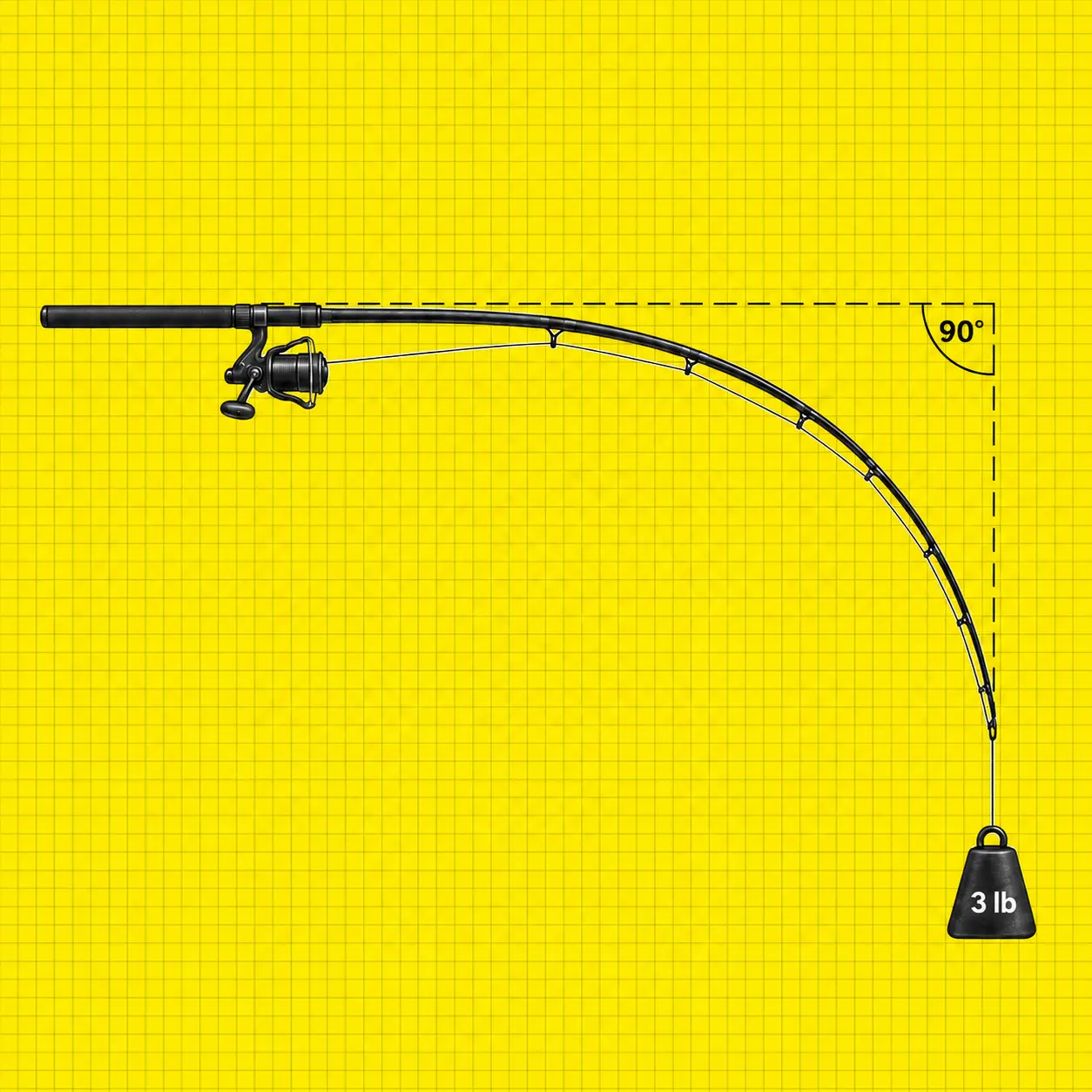
Caption: Diagram of bend curve measurement: a 3 lb load, about 1.36 kg, positions the tip’s end segment at a 90° angle relative to the horizontal butt’s axis. This value does not define casting weight or maximum fish weight.
What can you learn from the lb value?
Within similar constructions, a higher bend curve means greater blank resistance in this test. It may indicate more power reserve, but it does not describe the rod’s full characteristics.
From the 3.50 lb marking alone, you won’t know:
- how deeply the blank works under lighter loads;
- how quickly it recovers after bending;
- which rig best utilizes its potential;
- whether it will be comfortable during the final stage of the fight.
The measurement requires proper setup and controlled loading. When choosing gear, rely on the manufacturer’s specifications and comparisons of actual rod performance. Randomly lifting weights with the rod does not replace this test.
How to understand parabolic, progressive, and tip actions?
Action describes how the bend distributes along the blank under load. We look at which parts of the rod work and how their involvement changes as the load increases.
The division into parabolic, progressive, and tip action helps compare gear, but not all manufacturers use these terms identically. They describe the character of the rod’s behavior, not three rigid templates.
Parabolic action — deep blank bending
In a rod described as parabolic, the bend under appropriate load covers a large part of the blank and extends toward the butt. The angler feels clear rod activity during the fish’s runs.
This characteristic helps absorb sudden load changes. It is especially useful when the fish is close, and smooth reaction to its movements is needed.
For fighting fish from a boat on open water, I often choose rods with deep action. I appreciate their flexibility and the pleasure of playing fish. Without underwater obstacles, I can allow the fish to run instead of demanding stronger holding from the gear from the start.
However, deep bending does not replace proper drag use and rod handling. The term „parabolic” alone does not guarantee avoiding tight hooks.
You can also fish with a parabolic rod by casting. For short and medium distances, a properly chosen model can perform well. Delicate constructions with deep action usually are not the first choice for maximizing distance with heavy rigs.
Models mainly designed for boat fishing and playing fish are compared in the carp rods for boat fishing ranking.
Progressive action — bend developing with load
In carp rod descriptions, progressive action usually means gradual engagement of successive blank sections as the load increases.
Under lighter load, the upper part’s bend may be most visible. When the fish pulls harder, the middle part of the rod also clearly works. The extent of this transition depends on the specific model’s design.
You can imagine it as gradually involving more of the rod to do the work. There is no sudden switch between a „soft tip” and a „stiff butt”.
Therefore, do not define progressive action solely as „the rod bends halfway”. A single static image shows only behavior under a specific load.
A well-chosen progressive model can combine comfortable loading during casting with smooth action during the fight. That’s why I often recommend this characteristic to anglers looking for a rod for various fishing styles.
The term „progressive” may also appear in descriptions of deeply working blanks. Naming boundaries are fluid — the rod’s actual behavior tells the most.
Tip action — more pronounced upper section bending
In a tip action model, the bend under a given load is more concentrated in the upper part of the blank, while the rest offers greater resistance.
This does not mean the lower parts never work. Under heavier load, such a rod can also bend deeper.
Tip action is often found in models designed for longer casts. It can help utilize a stronger lower blank section but requires matching the rig and technique to the specific design.
During the fight, a rod with a noticeably stiffer middle section may provide more direct feedback. Especially when netting, smooth reaction to the fish’s runs and properly functioning drag are essential.
Not every tip action rod is difficult to handle. A flexible tip can cooperate with a strong butt, providing both casting reserve and cushioning during the fight.
You can find specific casting-oriented designs in the carp rods for long casts ranking.

Caption: Illustrative comparison of rod bends: from top tip action, progressive, and parabolic.
Action vs. blank dynamics — what does „fast rod” mean?
The term „fast” is used in two meanings. Sometimes it refers to tip action, sometimes to the quick recovery of the blank after bending. When discussing gear, clarify which feature is meant.
The bend shape and the rod’s behavior after unloading are different aspects. A blank can work deeply and simultaneously recover quickly, damping vibrations efficiently. This type of characteristic is found in top-tier rods, where material choice influences performance.
| Feature | What question does it answer? | What does it not define? |
|---|---|---|
| Bend curve in lb | What load is needed to achieve a specific bend in a static test? | Casting range and full blank action |
| Action | How does the bend distribute along the rod? | Speed of vibration damping |
| Blank dynamics | How does the rod react after bending and unloading? | Allowable weight of the cast rig |
Quick return to the starting position and vibration damping are also not exactly the same. The tip may quickly pass the starting position and then oscillate several more times.
When comparing gear, pay attention both to the blank’s return speed and how long its vibrations last.
Why can two 3.50 lb rods perform differently?
Imagine two rods of the same length and marked 3.50 lb. One works deeply under load, the other bends more in the upper part. The bend curve marking can be the same, even though the fishing feel will differ.
The lb number describes a selected test point. It does not show the full bend progression under varying loads or behavior during dynamic casting.
Therefore, you cannot assume that:
- every 3.50 lb rod will feel equally stiff;
- a tip action model will always cast farther than a progressive one with the same markings;
- two blanks labeled parabolic will work identically.
Same action, but different bend curve
A similar comparison applies to two close designs with deep, parabolic action marked 2.75 and 3.50 lb.
Both may have a similar bend character, but the stronger version will require more load to reach a comparable bend degree. So do not expect identical behavior under the same force on the rig.
In tougher conditions, a bigger power reserve can be useful. On open water, the lighter version may suit an angler who especially values rod action during the fight. The choice depends on conditions and preferences, not on the rule that higher lb means a better rod.
Carp rod 3.00, 3.25, or 3.50 lb — how to choose?
The following applications will help you choose a bend curve suitable for your fishing conditions. It’s best to compare models of similar length and construction, especially variants from the same series.
| Bend curve | Fishing by casting | Boat fishing and playing fish |
|---|---|---|
| 3.00 lb — universal starting point | Short and medium distances, classic rigs without particularly heavy bait additions. A good choice when you want to combine casting ability with pleasant rod action during the fight. | Boat fishing and playing fish from a boat on open water, without hard snags and dense vegetation. Also boat baiting and playing fish from the bank if conditions do not require a bigger power reserve. |
| 3.25 lb — intermediate option | Short and medium distances with heavier rigs, e.g., with a filled PVA bag or mesh. Worth considering when the lighter 3.00 lb variant leaves too little reserve for the used load. | Boat baiting and playing fish from the bank or boat fishing when you need more power reserve than a comparable 3.00 lb model but don’t yet require the strongest version. |
| 3.50 lb — bigger power reserve | Longer distances and heavier rigs, provided the load and technique match the specific blank. Especially worth comparing models designed for distance fishing. | Tougher conditions: presence of snags, denser vegetation, and the need to decisively control the fish’s escape direction. A bigger power reserve can be useful both when playing fish from the bank and from a boat. |
When boat fishing, the fight conditions mainly determine the choice. Simply baiting with a boat does not require a specific lb value.
When using PVA, consider the total rig weight — a small mesh and a large filled bag may impose very different demands on the rod. Always check recommendations for the specific model. Also remember the action: a bigger bend curve can cooperate with a deeply working blank, so 3.50 lb does not necessarily mean a stiff rod during the fight.
When do I choose a bigger power reserve?
When boat fishing and playing fish from a boat, I pay attention mainly to underwater conditions.
In open areas without underwater obstacles, I prefer a lighter blank with deep action. If conditions require stronger fish holding, I consider a bigger power reserve.
I still value cushioning. A stronger rod does not have to lack flexibility, and a higher lb value alone does not solve difficult fishing spots.
For different applications, it’s worth comparing not only markings but also the character of particular versions. The universal carp rods ranking will be helpful.
Bend curve vs. casting weight — how to consider rig and PVA?
There is no reliable universal conversion that translates lb into the maximum or optimal casting weight for every carp rod.
The bend curve comes from a static test. During casting, the load changes dynamically, and the blank’s construction, rig acceleration method, and angler’s technique also matter.
The rule „one lb equals one ounce of weight” can be found as a simplified guideline, but it should not be treated as a safety limit or manufacturer’s recommendation.
If the manufacturer provides the casting weight for a specific model, use that information. If not, it’s worth asking for recommended load instead of estimating it solely from the lb number.
The total weight of the cast rig matters
When fishing with PVA materials, the weight of the sinker is only part of the total mass.
For example:
- sinker: 100 g;
- filled PVA mesh: 20 g;
- other rig components with bait: 5 g.
Altogether, this gives 125 g.
This is an example calculation, not a recommended weight for a 3.00 or 3.50 lb rod. It’s best to weigh your own rig as prepared for casting.
Also consider its size. A compact mesh and a bulky PVA bag of similar weight may behave differently in flight. Greater air resistance can limit casting distance.
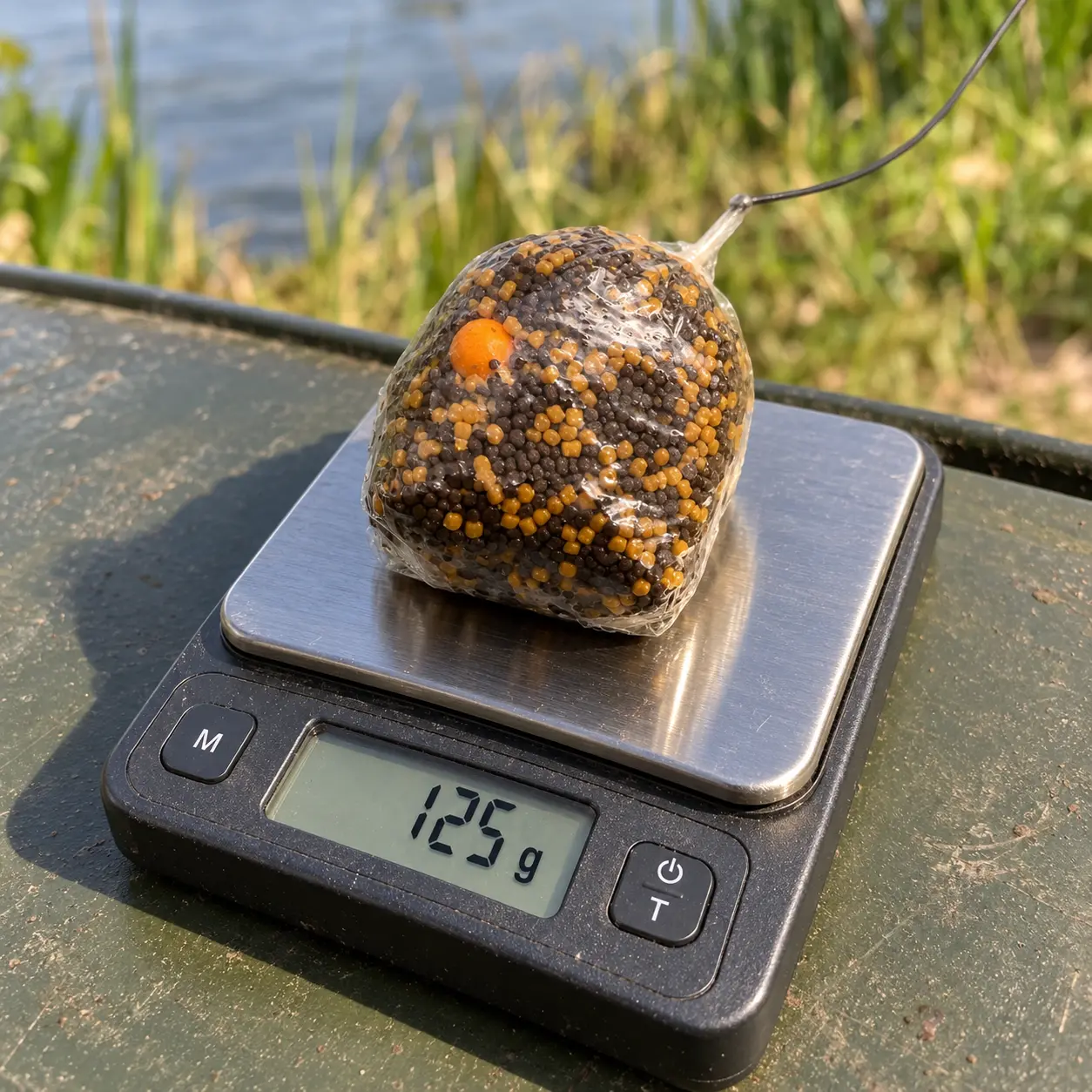
Caption: When selecting load, consider sinker, bait, rig components, and filled PVA. The most reliable result comes from weighing the ready-to-cast rig.
What does casting weight given in oz mean?
If the manufacturer states casting weight as 3–5 oz, it means mass in ounces — approximately 85–142 g. This is a different type of information than the 3–5 lb bend curve. Usually, oz markings are used in rods dedicated to long-distance casting.
Similarly, baiting with a catapult requires separate consideration. The weight of the loaded catapult and repeated casts require matching gear for this use. We cover this topic in the baiting rods ranking.
How to assess rod action before purchase?
Moving the rod in your hand can give initial information about perceived stiffness and vibrations. However, this is not enough for a full assessment of action or casting capabilities.
When comparing models, pay attention to four things:
- Behavior under lighter load. Does mainly the tip react, or does a larger part of the blank clearly work?
- Change in bend as load increases. Do successive sections engage smoothly?
- Behavior after unloading. How quickly does the blank return and how long do vibrations last?
- Compatibility with your rig and technique. If possible, test the rod over water to evaluate casting repeatability and fight comfort.
The bend demonstration should be done under controlled load. Ask the seller for this instead of trying to bend the rod strongly by holding only the tip.
When comparing carp rods, note the specific variant: length, bend curve, and action description. A series name may cover several rods with distinctly different characters.
The entire gear selection process — from fishing style to other parameters — is detailed in the guide how to choose a carp rod.