
How to Choose Feed Boilies? Flavour, Size and Feeding Method
Choose your bait boilies according to the fishing venue conditions, session duration and planned baiting quantity. Select a range you have justified confidence in, then match the diameter, flavour profile and the way the boilies work in the water to your intended fishing approach.
Add Rockworld-carpshop.com to your preferred sources in Google!
Table of contents
Feed Boilies vs Hookbaits: Where to Start When Choosing?
Feed boilies are introduced loosely into the swim to create an area with available food for the fish. A hookbait is positioned next to the hook, most often on the hair. These two uses can overlap: a sufficiently durable feed boilie can also be used as a hookbait if it suits the rig and presentation method.
Specialist hookbaits may have a different hardness or buoyancy than boilies used for baiting. Therefore, choosing feed boilies does not yet determine what should be placed on the hair.
I often use a hookbait in a size similar to the boilies scattered in the swim. I also sometimes use two boilies, especially when other fish species are causing problems, or make the hookbait stand out with a different colour. This is a separate decision that I make after establishing the baiting approach.
How to Assess the Quality and Composition of Feed Boilies?
The first criterion in my choice is trust in a particular range and its manufacturer. I base this on my own fishing experience, opinions from trusted people and information about the ingredients used. I mainly use several proven options.
When baiting with small quantities of boilies, I am more willing to choose a more expensive, proven range. When I need larger quantities, I look for an economical base from manufacturers I trust. I do not automatically choose the cheapest pack.
What Can You Check After Breaking a Boilie Open?
The appearance, smell and structure of a broken boilie provide information about the product, but they do not allow you to recreate its recipe or determine the quality of all raw materials. A finely ground mix may look similar in two ranges with completely different compositions. Visible large particles are also not enough to consider one boilie better than another.
A bucket test has similar limitations. You can observe softening, swelling or breakdown, but the appearance of the water alone does not show which substances, and in what concentrations, are released by the boilie. The speed of visible breakdown is not an independent measure of quality or effectiveness.
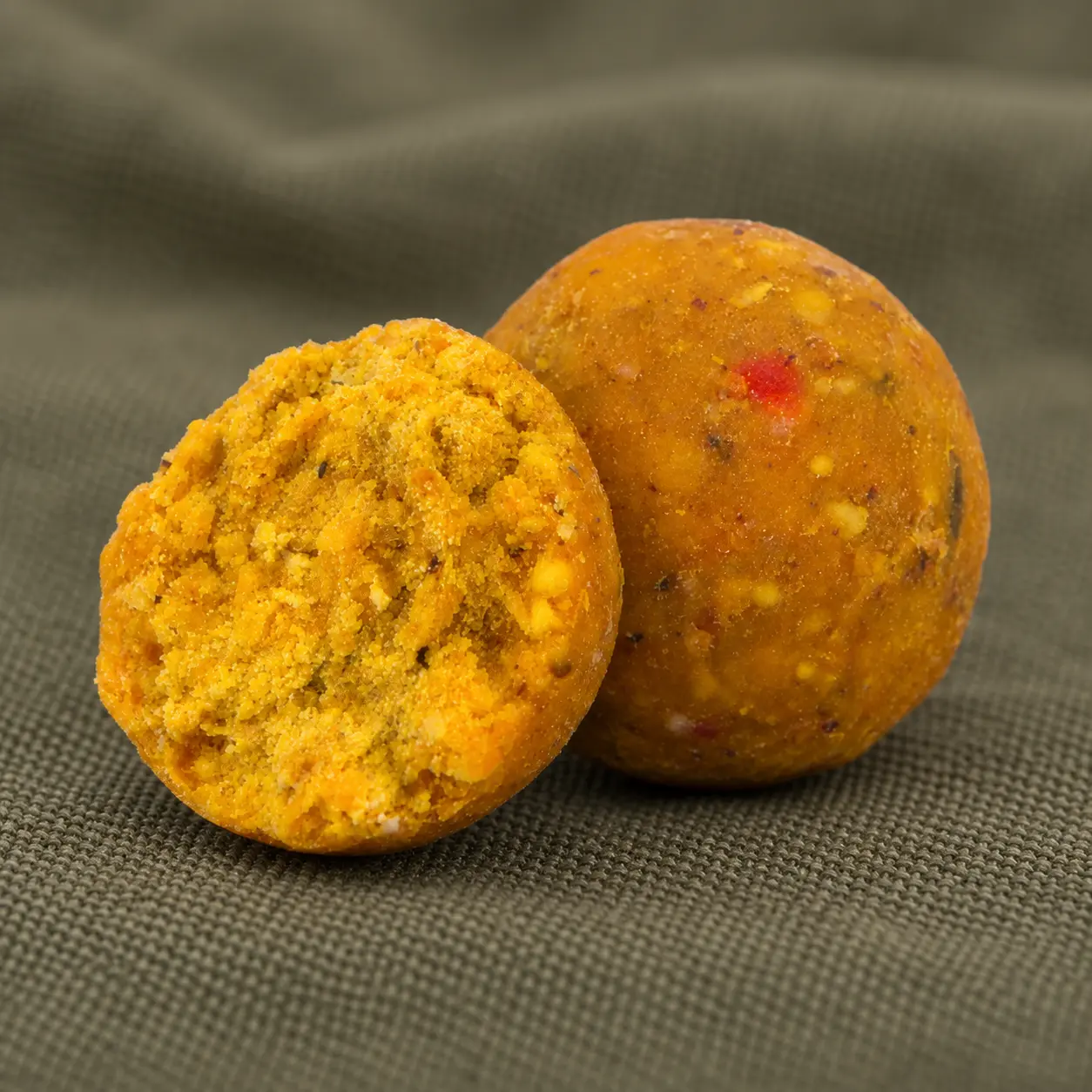
The cross-section of a boilie shows the structure of the mix, but it is not enough to assess the quality of all ingredients.
How to Read Composition Information?
Separate ingredients declared by the manufacturer from the flavour name. Information about the use of a particular meal, extract or proteins says more about the recipe than the term „crab” or „vanilla” alone.
Do not draw conclusions about the digestibility and suitability of a boilie solely from its percentage protein or fat content. The proportion of these ingredients alone does not describe the entire recipe or how fish will respond to the product in your venue.
How to Match Boilies to the Venue and Session Duration?
Before my first trip, I try to gather information from anglers who have already fished the venue. I am interested in the presence of other fish species, the baiting methods used so far and the boilies that have been taken. I treat such tips as a starting point for my own fishing.
If I do not have this information, I rely on my own experience from similar waters. I compare the type and size of the venue, the time of year and the available natural food. The two scenarios below show how I translate this information into boilie selection.
A Short Autumn Session on a Small Gravel Pit
For a 24–48-hour trip to a gravel pit of around 10 hectares, with a strong population of large carp and little nuisance fish, I choose feed boilies measuring 20–24 mm. In this autumn scenario, I am keen to use a strong-smelling profile, often with a distinct spicy note.
I bait sparingly: from a dozen to several dozen boilies per rig. During a quick session, this amount may also be my initial baiting. I want the fish to have a chance of finding the hookbait on the hair within a limited time, so I do not start by creating a large bed of food.
I then choose a proven premium range. With a small number of boilies, I can allocate more of the budget to a particular product without having to buy many kilograms.
A Week-Long Summer Session on a Large Lake
On a large lake, with plenty of nuisance fish and carp exceeding 20 kg, I often choose 22–24 mm feed boilies. I also look for suitable durability, because a large diameter alone does not solve the problem of food being eaten by other species.
In summer, I consider a wide choice of flavours. Personally, I am keen to use profiles associated with crustaceans and mussels, for example crab or GLM (Green Lipped Mussel, meaning New Zealand mussel), as well as ranges whose declared composition suits this direction.
When fishing with two rods, I try different baiting approaches. I may bait one spot more heavily and the other much more sparingly, especially near an area rich in natural food. Even on a large lake, a dozen or several dozen boilies placed around the rig may be my choice.
For heavier baiting, I use an economical base enriched with a more expensive range with a similar scent profile. I adjust the amount of food introduced to the specific spot and the course of the session.
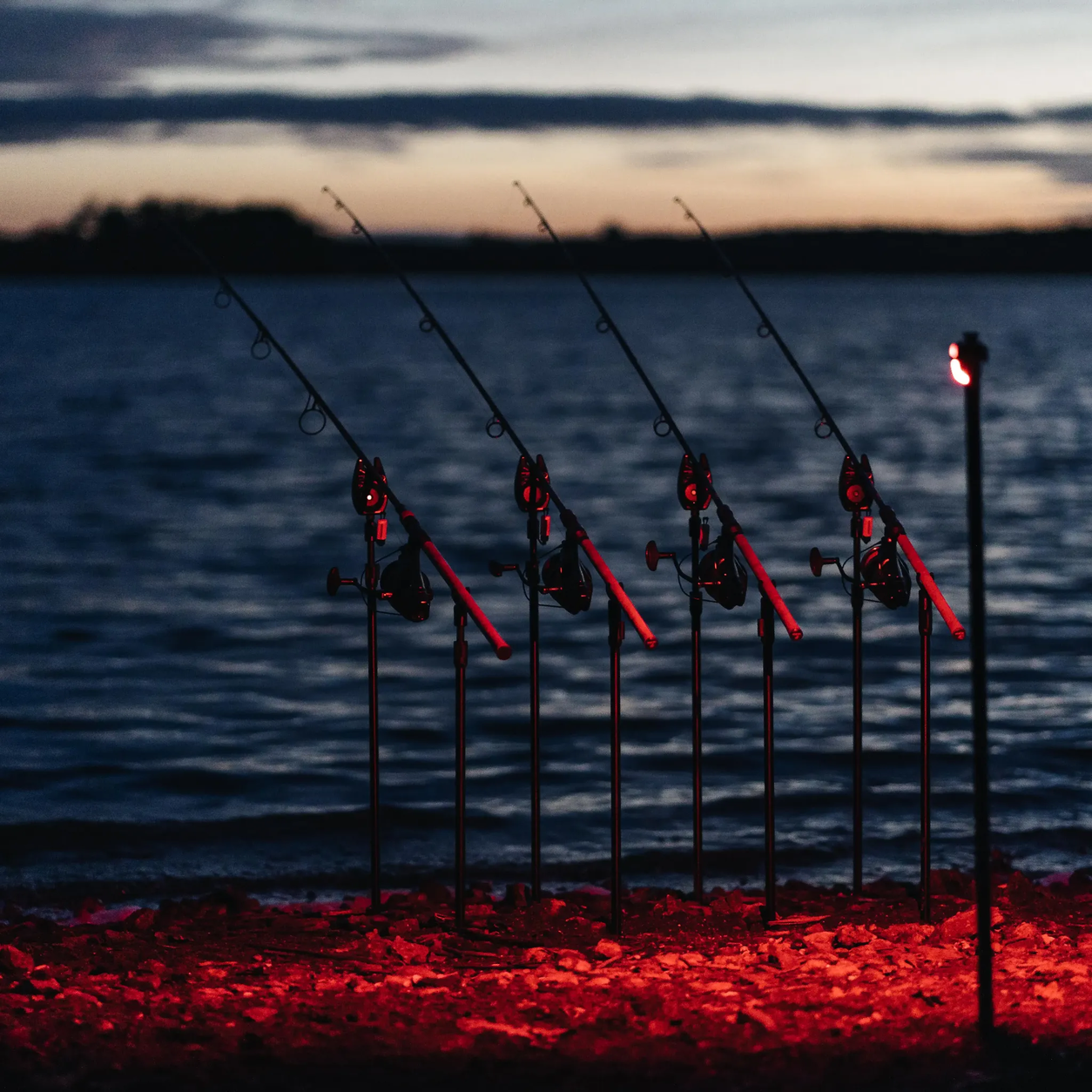
A lakeside swim prepared for carp fishing.
Which Scent Profile and Flavour of Boilies Should You Choose?
The scent profile defines the broader character of a boilie. Available options include strong-smelling, fruity, nutty, sweet, creamy, herbal and spicy boilies. The flavour indicates a more specific variant, such as strawberry, crab or Scopex.
This information helps narrow down the choice, but it does not define the nutritional value of the product. A boilie with a fruity flavour may contain fish-based ingredients, while the name of a crab flavour does not yet confirm the presence of crab meal. If you are looking for a particular ingredient, check the manufacturer's declaration - if the boilie is rich in such ingredients, the manufacturer will certainly highlight this.
On gravel pits where I encounter crayfish or mussels growing on submerged trees, I often start with crab, crayfish, krill or GLM profiles. This is how I select my first option based on my experience from similar venues. However, I do not assume that fish must prefer it simply because this type of food is present in the water.
There are venues where this method of selection does not work. In such cases, observing fish response and comparing other boilies remains necessary. Information that a particular flavour was effective elsewhere does not determine its advantage on another water.
How to Choose the Diameter and Shape of Boilies for Baiting?
I consider the diameter of feed boilies together with the presence of other fish species, the durability of a particular range and the method of introducing them. In the scenarios I have described, the 20–24 mm and 22–24 mm sizes refer to boilies for baiting. The hookbait on the hair may be a similar size, but it does not have to be identical.
A larger boilie may reduce interest from some smaller fish. However, it does not provide full protection from being eaten or nibbled, especially when larger bream or crayfish are a problem. Resistance also depends on hardness and the recipe. A large, soft boilie may not behave in the same way as a smaller, noticeably harder one.
A mix of diameters allows different food sizes to be introduced, while crushed boilies or halves change its form. These are options that can be adapted to the baiting plan, without the need to stick to one diameter throughout the entire trip.
I also consider shape when choosing the delivery method. When baiting with a throwing stick, I check whether the size, shape and hardness of the boilies suit the model being used. The ability to introduce round boilies does not automatically mean that dumbells are equally suitable for this purpose, especially at longer baiting distances.
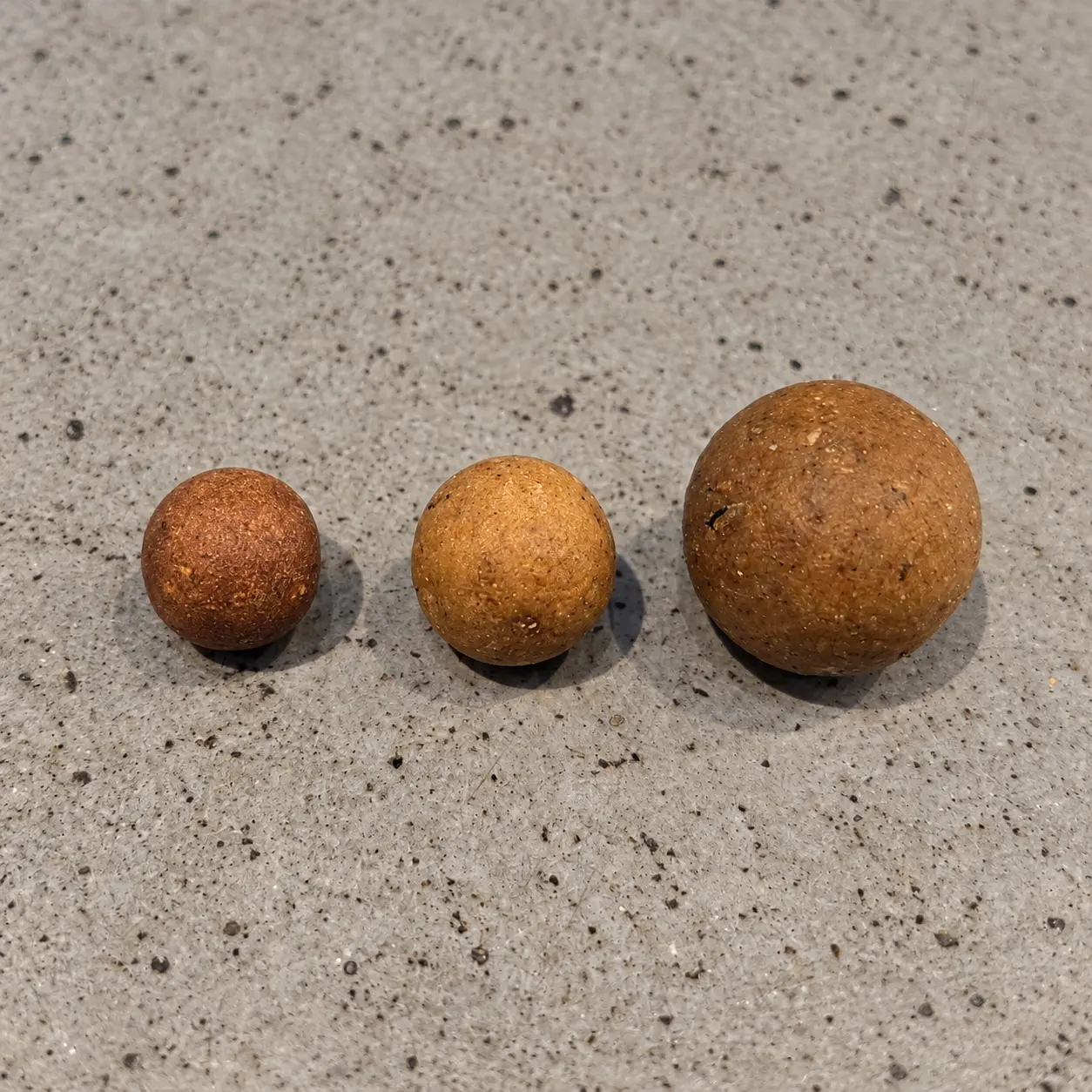
A comparison of different feed boilie diameters in a single shot.
Standard or Soluble Boilies?
The terms „standard” and „soluble”, often marked as soluble, refer to how boilies work in water. This is a separate characteristic from flavour, buoyancy or storage conditions.
Standard boilies may soften and release ingredients while retaining their form. In products marked as soluble, their gradual breakdown is an important characteristic. The presence of soluble ingredients in the recipe alone does not mean that the entire boilie belongs to the soluble type.
When choosing a product, check the description of the particular range. There is no single breakdown time that applies to all soluble boilies. The recipe, water temperature and the conditions in which the boilies are used all matter.
A test in a container can help compare the behaviour of two products if you use the same water and maintain similar conditions. However, the result only describes that test. It does not account for boilies being nibbled by fish and crayfish in the swim, or for water currents.
How to Consider Water Temperature and the Time of Year?
For me, the time of year is part of assessing the venue. However, I do not assign one flavour to all waters for the entire summer or autumn.
In the autumn scenario described above, I choose a strong-smelling profile with a spicy note. In summer, I allow for both such boilies and fruity or sweet flavours. This is a choice based on my fishing approach or information about the water, rather than a rigid flavour calendar.
In cold water, first check how the chosen range behaves and whether the amount of food introduced matches fish activity. The name „fishy” or „sweet” alone does not explain how a boilie will work in these conditions.
Also consider where the fish are holding. A spot suitable in early spring may differ from one that offers a chance of contact with carp in mid-summer or late autumn. Choosing a flavour will not replace finding an area where fish are feeding.
How to Choose the Amount of Boilies and Pack Size?
The size of the first portion and later top-ups depend on the venue, conditions and the course of the session. I do not use one fixed amount per rig or a set number of kilograms per day.
On quick trips, I sometimes start with a dozen to several dozen boilies per rig. On large waters, however, I may initially introduce several or even a dozen kilograms of boilies. Such baiting may be sufficient without quick replenishment, and when placing the rig I often do not top up at all or use only a minimal amount, but there are also situations in which the next portion during top-up baiting or when positioning the rig in the swim amounts to several kilograms.
These are different approaches. The size of the lake alone does not justify introducing a dozen kilograms of boilies. The decision requires assessing the specific spot, the presence of fish and what is happening to the introduced food.
Only then should you select the pack size for this plan:
| Pack weight | When should you consider it? |
|---|---|
| 1 kg | When testing a new range or during a short session with sparing baiting. |
| 5 kg | When you plan greater use or several trips with the same boilies. |
| 10 kg | For heavy baiting or regular use of a proven range. |
Before buying, compare the actual price per kilogram and the storage options for the remaining boilies according to the manufacturer's recommendations. A large pack makes sense when it matches the planned usage.
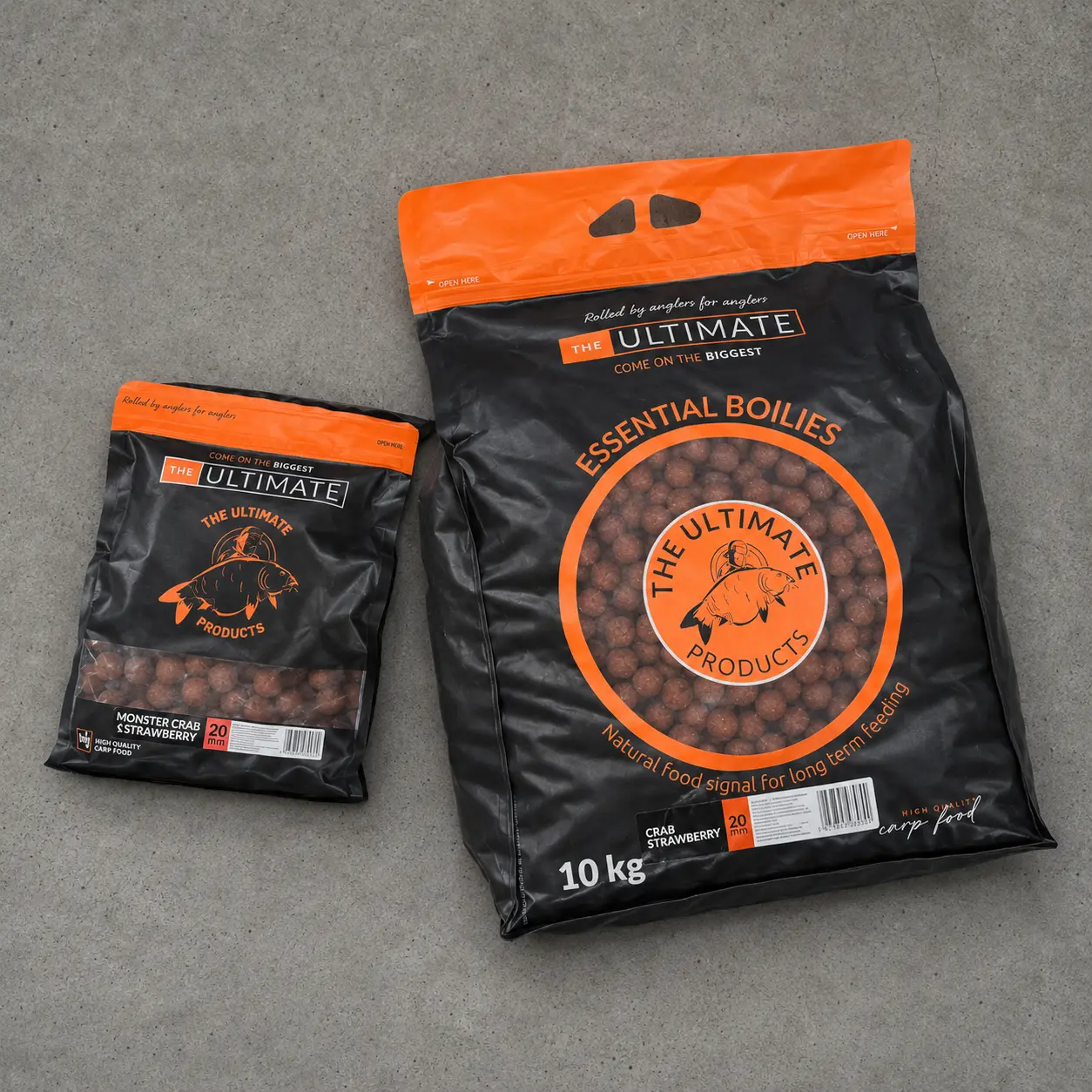
The pack size should be matched to the planned use of boilies.
Combining an Economical Range with More Expensive Boilies
When baiting heavily, I combine an economical base with a proven premium range, choosing boilies with a similar scent profile. One of my starting ratios is 10 kg of economical boilies and 1 kg of premium boilies.
This creates 11 kg of mix. The 10:1 ratio describes its composition; the amount introduced during one baiting session depends on the situation at the water. Adding a more expensive range is not in itself confirmation of the effectiveness of the entire combination.
Once you have defined your baiting plan and the required amount of food, compare feed protein boilies. Filters for scent profile, flavour, diameter, shape, boilie type and pack weight help narrow the choice down to products that meet these requirements.
What Should You Check When Baiting Does Not Produce Takes?
When there are no takes, I first check the spot and consider changing it. Even a boilie I have great confidence in will not help if I introduce it outside an area visited by fish.
If I have grounds to consider the spot suitable, I look at the hookbait presentation and the rig. Fish may be taking the feed boilies while avoiding the hookbait next to the hook. In that case, another flavour does not necessarily have to be the first change required.
An underwater camera can be helpful. Seeing feed protein boilies that have been eaten while the hookbait is ignored provides grounds for a more detailed assessment of its positioning and the way the hooklink works. The food may also have been taken by other fish species or crayfish, while assessing the remaining boilies requires consideration of their breakdown.
When checking presentation, the entire connection between the hookbait and the carp rig matters. I discuss hooklink selection and testing in water in more detail in the guide how to match a hooklink to a pop-up, wafters and a bottom bait.
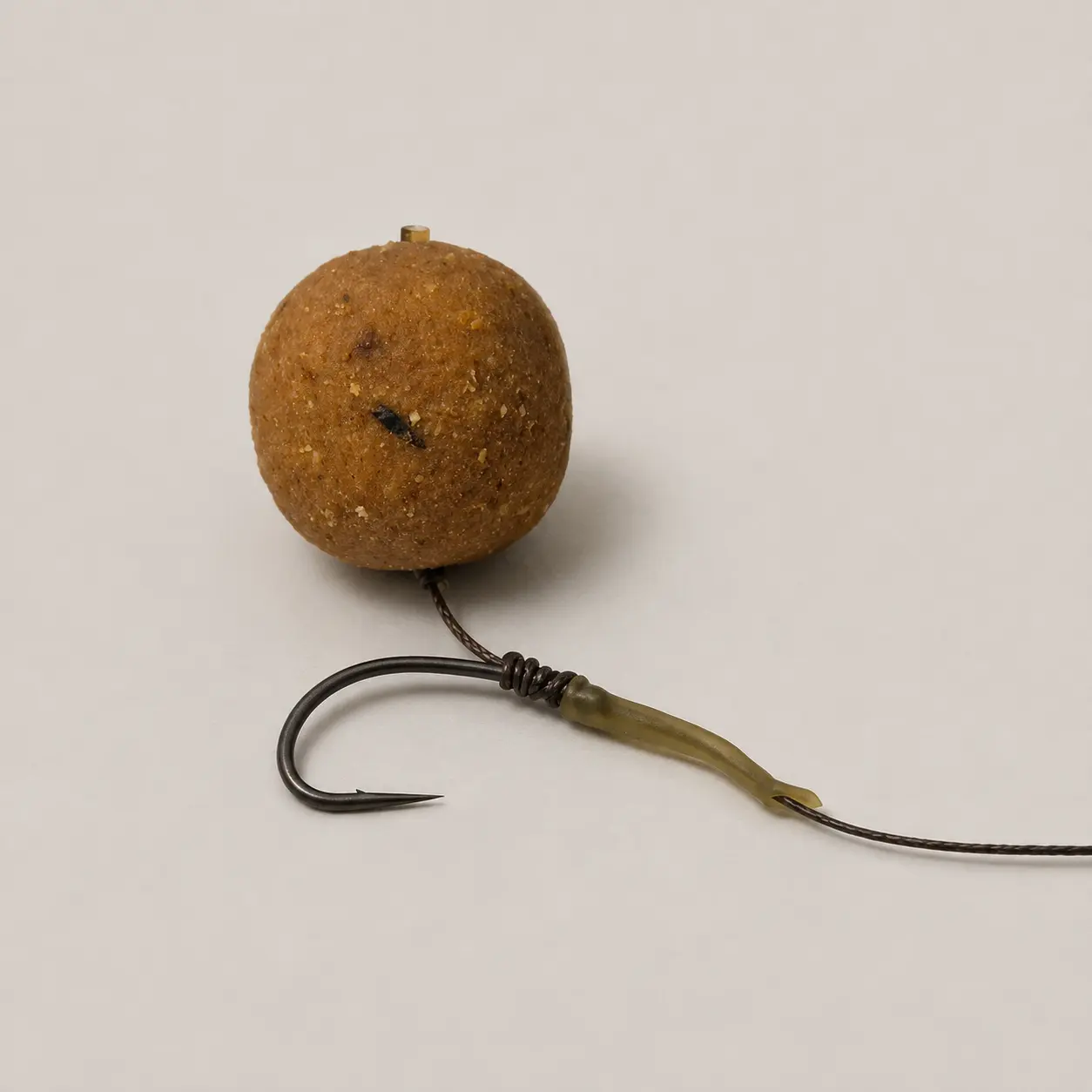
Hookbait presentation is assessed together with the hook, hair and the remaining components of the hooklink.
