
Carp Mats — How to Choose a Mat and Use It Safely?
Choose a carp mat according to the size of the fish, bank conditions, and the requirements of the fishing spot — it should comfortably fit the entire carp with some extra space, effectively separate it from hard ground, and allow for easy unhooking and lifting. The choice between a flat mat, a model with sides, an inflatable design, or a cradle on a frame also depends on transport and fishing style. Below, we explain the differences, highlight the key features of quality gear, and offer tips on how to prepare the mat to receive the fish.
Add Rockworld-carpshop.com to your preferred sources in Google!
Table of contents
- What is a carp mat and what does it protect the fish from?
- What types of carp mats are there?
- Flat mat, with sides, inflatable or cradle — comparison
- What to consider when choosing a carp mat?
- How to match the mat to your fishing session?
- How to safely use a carp mat?
- How to care for your mat after the session?
- Where to compare specific mat models?
- Frequently asked questions about carp mats
Practical tips for this guide were provided by Adam Skrzypek — customer advisor and content manager at ROCKWORLD, involved in carp fishing for over 20 years. In this article, we use his experience with flat mats and cradle mats on frames, as well as observations from advising customers in the store.
What is a carp mat and what does it protect the fish from?
A carp mat is used to protect the fish during necessary shore-side activities such as unhooking and preparing for weighing or photographing. It separates the carp's body from the ground and reduces the risk of abrasions and injuries. Stones, gravel, sand, or branches should not come into direct contact with the fish.
The term “fishing mat” has a broader meaning — it covers equipment for unhooking fish caught by various methods. When choosing a model for carp fishing, the key factors are its actual dimensions, construction, and the way it supports the fish.
A cradle on a frame is also a type of carp mat. Its distinctive feature is a working surface suspended on a frame and raised above the ground. A mat with sides can lie directly on the ground, although it is also colloquially called a cradle.
No model replaces proper handling of the carp. The mat’s role is to reduce risk during necessary procedures, not to enable long-term holding of the fish out of water.
What types of carp mats are there?
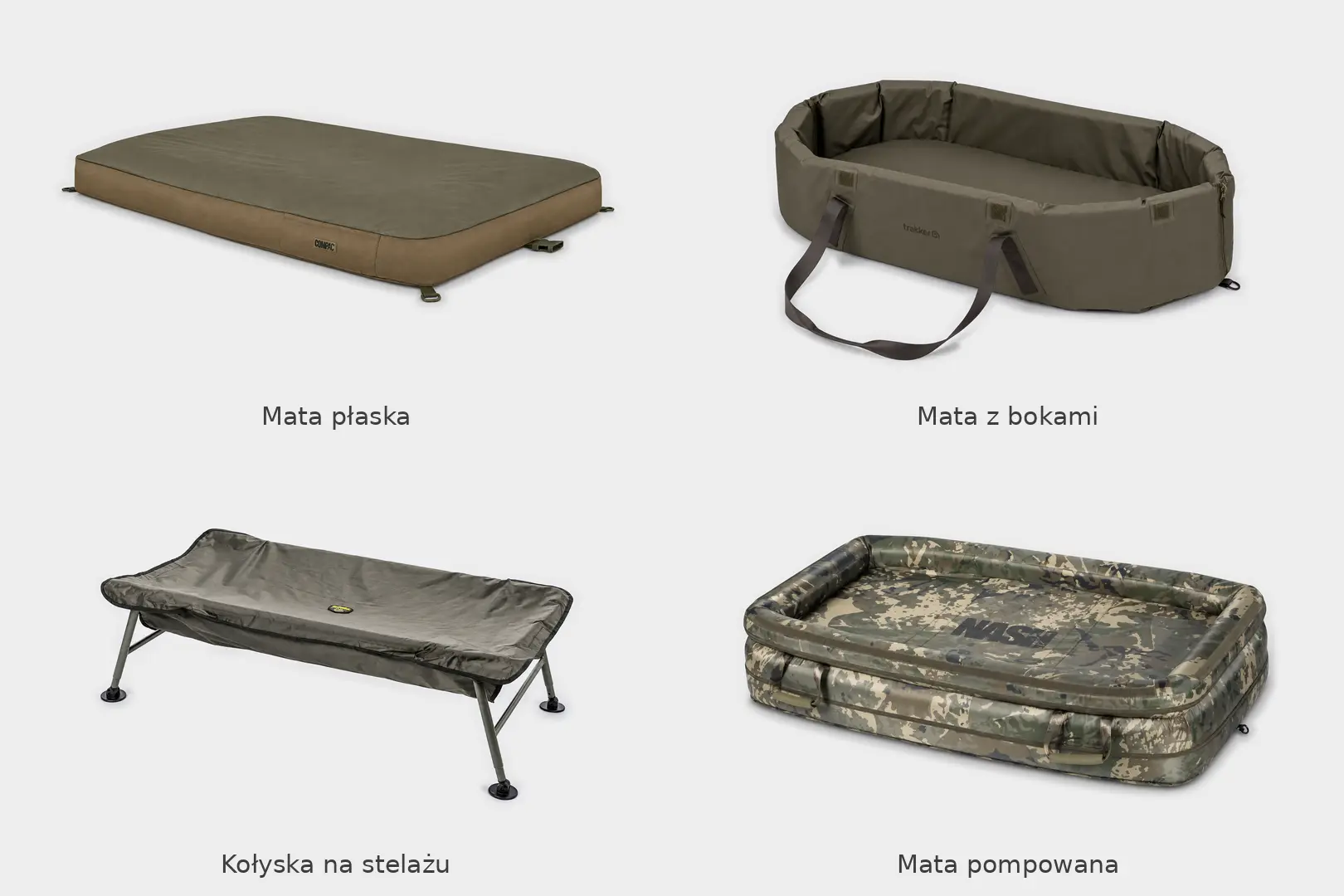
At ROCKWORLD, we distinguish flat mats, mats with sides, cradle mats on frames, and inflatable mats. This classification helps when browsing equipment, although individual features may overlap. For example, an inflatable mat often has high sides, and a separate mattress may support the fish.
Flat mats — unrestricted access to the fish
A flat mat lies on the ground, so its padding is especially important. The mattress should protect the fish under load, not just feel soft when the empty product is viewed.
The biggest advantage of this design is convenient access to the carp. It’s easy to slide your hands under the fish, and when preparing for a photo, you don’t have to lift it over a high edge. Adam highlights this convenience especially for large, heavy carp, whose lifting requires proper support and calm movements.
The limitation is the lack of high sides. A sudden movement can cause the fish to slide off the mattress directly onto the ground. A large surface offers more space but does not replace constant supervision.
Among flat carp mats, there are both small models for easy transport and large, thickly padded mattresses. The latter can protect well from the ground but do not always take up little space when packed.
Choose a flat mat based on mattress quality and ease of use, not just small size or low price.
Mats with sides — additional protection of the working surface
Raised sides reduce the chance of the carp sliding off the mat. Many designs include a protective flap, and foldable or detachable elements facilitate transport and access to the interior.
Side guards are a significant advantage over a completely open surface. However, they come with a compromise: a deeper chamber can make it harder to slide your hands under the fish and lift it for a photo.
High sides do not replace a good mattress. If the bottom lies on the ground, it still must properly separate the carp’s body from the hard surface. When choosing, evaluate side protection and the part supporting the fish’s weight separately.
When comparing carp mats with sides, also check the folding method. A model that creates a spacious chamber by the water may take up much less space when the sides are folded. Rigid or very thickly padded elements may require more room in the car.
Cradles on frames — surface raised above the ground
A cradle holds the fish in a chamber suspended on a frame. When properly set up and loaded according to its purpose, the working surface should not touch the ground. The stability of the legs, mechanism locks, and protection of hard frame parts are very important.
This is Adam’s current choice. Previously, he used cheaper flat mats that absorbed water and did not meet his expectations. The cradle worked well in his conditions and is also required at the waters he most often visits.
The compromise is transport. A rigid frame requires planned space and stable placement in the luggage. The chamber’s depth and frame height can also make lifting the fish more difficult, although individual models differ significantly in access to the interior.
When browsing carp cradles, pay attention to leg adjustment, fold locks, transport dimensions, and frame protection. The mere presence of a frame does not guarantee product quality or safety.
Inflatable mats — air chambers and unfolding method
Inflatable mats allow reducing the volume of chambers for transport. This is a significant advantage for large designs with high sides. The final packed size also depends on the cover, additional mattress, and included pump.
Inflatable sides do not automatically mean an inflatable bottom. Some models have a separate foam mattress under the fish. When assessing protection from the ground, check what actually supports the carp’s body rather than relying on the construction’s name.
Models requiring a pump add time for inflating and deflating chambers after the session. Self-inflating designs are prepared differently, so it’s worth learning the operation of a specific product before your trip.
Selected inflatable carp mats are also suitable for certain water applications. However, this must be specified by the manufacturer. The mere fact that an empty mat floats does not confirm it can be used to carry carp or hold fish on the water surface.
Flat mat, with sides, inflatable, or cradle — comparison
| Need or condition | Flat mat | Mat with sides | Cradle on frame | Inflatable mat |
|---|---|---|---|---|
| Protection from hard ground | All work is done by the mattress — thin, compressible padding is a poor choice. | Sides do not improve bottom support — the mattress remains key. | Structural advantage: the chamber is raised above the ground. Stable setup is necessary. | Check the bottom: air-filled sides do not replace a mattress under the fish. |
| Preventing an energetic fish from sliding off | Least side protection. Open surface makes it easier for the fish to leave the mat. | Sides create an additional barrier; their height and stiffness matter. | The chamber limits movement, but the fish still requires constant supervision. | Models with high sides form additional barriers. |
| Sliding hands under and lifting a large carp for a photo | Most unrestricted access: no need to lift the fish over a high edge. | High sides hinder access; an opening side can improve it. | Deep chamber and frame may complicate lifting, especially when kneeling. | Wide, high chambers can make reaching under the fish difficult. |
| Frequent changes of fishing spot | Convenient choice: quick folding, no frame or pumping. Check weight of large models. | Look for quickly foldable or pop-up designs. | Frame requires space on a trolley and stable mounting. | If you must deflate before each move, transport becomes time-consuming. |
| Limited car space | Easier to fit between luggage, but thick mattresses retain volume. | Depends mostly on side folding and padding thickness. | Rigid frame limits packing flexibility. | Advantage when chambers are deflated: smaller volume; separate mattress and pump still take space. |
| Minimal preparation by the water | Unfold and check the surface. | Unfold and set or fasten sides. | Unfold frame, lock and level legs. | Fill chambers and check their condition; operation depends on model. |
| Water requiring a cradle on frame | Does not meet this requirement. | Does not meet the frame requirement even if called a “cradle.” | Proper group, provided the model also meets the water’s size requirements. | Inflatable design alone does not meet the frame requirement. |
Adam Skrzypek’s tip: when choosing, start with the rules of the water where you want to use the mat and the appropriate surface area for the fish. Only then compare transport convenience and carp lifting. A large mat that you can set up stably and handle comfortably is a wiser choice than a small model bought solely to save space.
What to consider when choosing a carp mat?
Internal dimensions and space for the fish
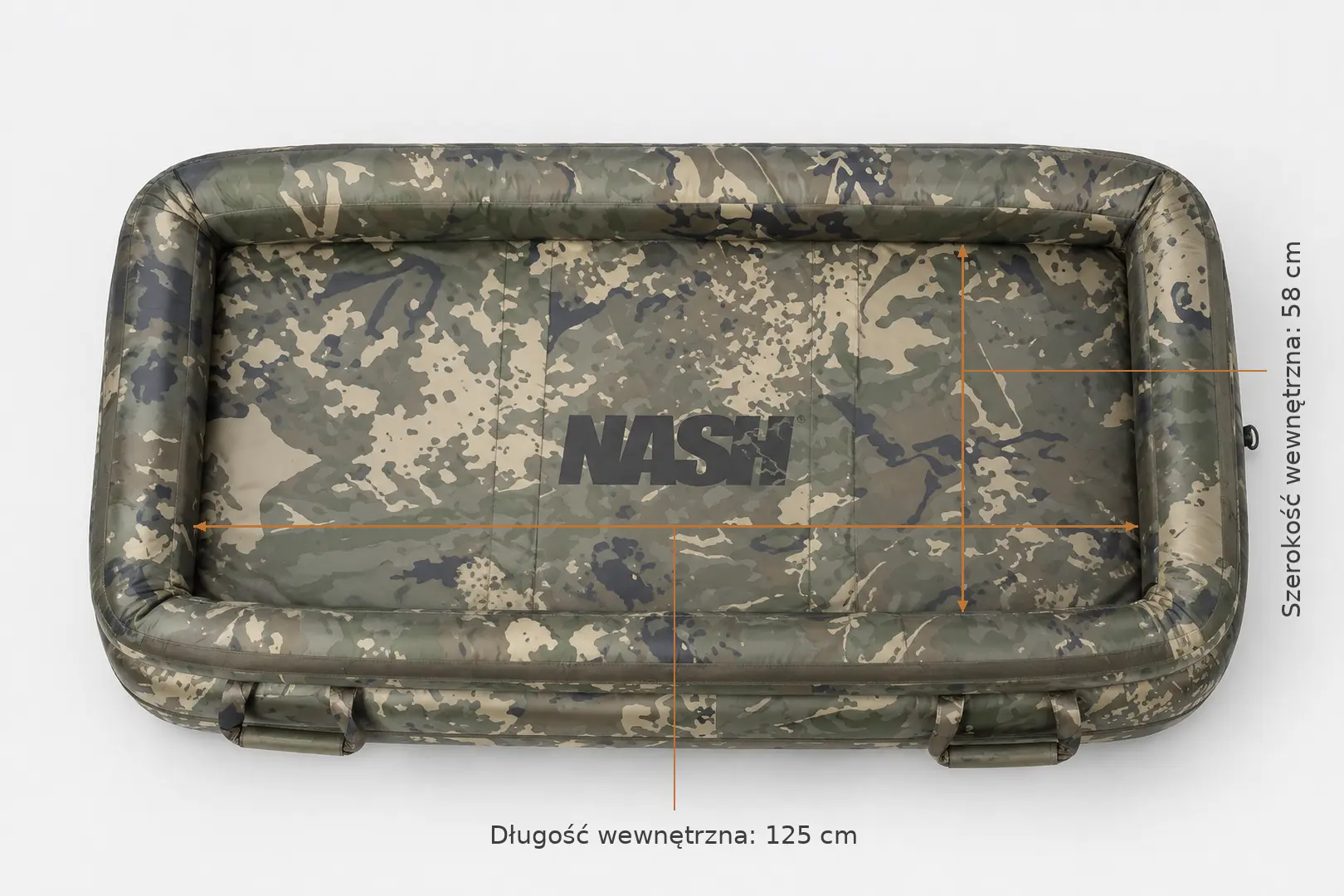
Start with the size of carp you can realistically catch at the given water. Don’t limit yourself to the average size of your previous catches. The fish should fit entirely on the designated surface with enough room for comfortable handling.
Adam follows a simple rule:
It’s better for the carp mat to be too large than too small for the fish.
In practice, this means choosing the largest mat you can safely transport and set up at your spot. A large cradle set up unstably on too small a platform is also not a good solution.
Compare the internal surface dimensions. External length may include thick sides or frame. XL and XXL labels do not replace measurements, and the carp’s weight alone doesn’t tell the whole story about its length and build.
Padding, cover, and build quality
For mats lying on the ground, the mattress must reduce contact between the fish’s body and uneven surfaces. Thickness, type of padding, and its behavior under pressure matter. A thick, easily compressible layer may not protect better than a well-chosen thinner padding.
When advising on flat mats, Adam uses about 5–6 cm of good quality foam as his baseline. He especially discourages thin models with 2–3 cm padding for large fish and hard, uneven banks. This is a practical expert criterion, not a universal standard — foam properties and behavior under the carp’s weight also matter.
The cover should be suitable for contact with the fish and allow wetting and cleaning. Also check seams, zippers, and handle attachments. Padding that constantly absorbs water is hard to dry, especially during frequent sessions.
Welded seams can reduce water penetration through material joints. However, this does not mean the entire construction will remain waterproof regardless of its condition. When buying, also check the cover quality, mattress closure method, and whether it can be removed.
Stability, protection, and access to the fish
Evaluate the mat as you will use it. Can you comfortably kneel by it? Is it easy to slide your hands under the carp? Do the sides or frame force uncomfortable reaching or lifting too high?
For cradles, check stability, locks, and protection of parts the fish might contact. Leg adjustment helps with setup but does not justify using the equipment on any steep bank.
The ideal model for you should combine effective separation from the ground, reduced risk of falling out, and convenient access to the fish. Side height alone does not describe all these features.
Transport and preparation for fishing
Before purchase, check the weight of the set and packed dimensions. Consider where you will place it in the car or on a trolley and how you will transport a wet mat after a rainy session.
If you frequently change spots, folding time matters. For longer sessions, it’s easier to accept a larger package in exchange for working surface and comfort. For inflatable models, also consider the pump and time needed to prepare chambers.
Don’t assume every flat mat is handy or every cradle hard to transport. Compare specific dimensions and folding mechanisms.
How to match a mat to your fishing session?
Adam starts the purchase conversation with the fishing location. If the rules require a specific design or minimum dimensions, this must be considered before comparing products. Don’t assume every commercial water has the same requirements.
| Fishing conditions | Priority when choosing |
|---|---|
| Frequent changes of spot | Convenient transport and quick setup while maintaining adequate surface and protection |
| Longer session | Comfortable access to the fish, stability, and space around the mat |
| Water with large carp | Extra internal dimensions, proper support, and compliance with manufacturer’s restrictions |
| Hard or rocky bank | Safe setup location and effective protection from the ground |
| Requirement for a cradle in the rules | Model meeting the exact water requirements |
| Planned use of the mat in water | Use permitted by the manufacturer and safe access to water |
With a limited budget, Adam prefers to consider a simpler, stable cradle over a thin flat mat for difficult ground. However, it’s not worth choosing solely by price and construction name.
Fewer extras can be a reasonable compromise. Too small a surface or ineffective padding are not.
How to safely use a carp mat?
Before fishing, choose a stable spot that allows you to kneel comfortably by the mat and safely approach it from the water side. Check the setup, remove sand, stones, and tackle parts from the surface. Wet the mat before placing the carp and make sure it hasn’t heated up in the sun.
Prepare water, tools, and equipment for planned procedures beforehand within reach. Never leave the fish unattended, even in a deep cradle or under a protective flap. Lift it low over the mat, limiting out-of-water time to the necessary minimum. If the fish’s weight makes stable support and control difficult, get help from another person.
Choose the mat as part of your safe fish handling gear. Other accessories can be found in the carp protection, weighing, and storage section.
How to care for your mat after a session?
After fishing, remove slime and dirt, clean the mat according to the manufacturer’s instructions, and dry it thoroughly before long-term storage. If you must transport wet gear in a bag, unfold it again after returning.
Before next use, check the condition of the cover, padding, and structural elements. Also follow hygiene rules required at the water. Cleaning and drying are important both for mat durability and reducing the transfer of contaminants and organisms between waters.
Where to compare specific mat models?
Once you know which construction suits your fishing, proceed to product comparisons. In separate rankings, we discuss parameters, advantages, and limitations of selected models:
- Ranking of carp cradles on frames.
- Ranking of carp mats with sides.
- Ranking of flat carp mats.
- Ranking of inflatable carp mats.
The full offer including various constructions is available in the carp mats category. When comparing two products, return to three questions: will the fish fit with room to spare, what separates it from the ground, and will you be able to work comfortably at the mat?